
Grindr Clone App
Launch your own location-first gay dating app built to your exact vision. Our Grindr clone pairs the proximity grid, private chat, and profile tags with the safety architecture this audience requires: distance privacy, a discreet app icon, quick exit, and consent-first data controls. You set the markets, the rules, and the pricing. You own the source code and every revenue stream from launch.
What Is a Grindr Clone?
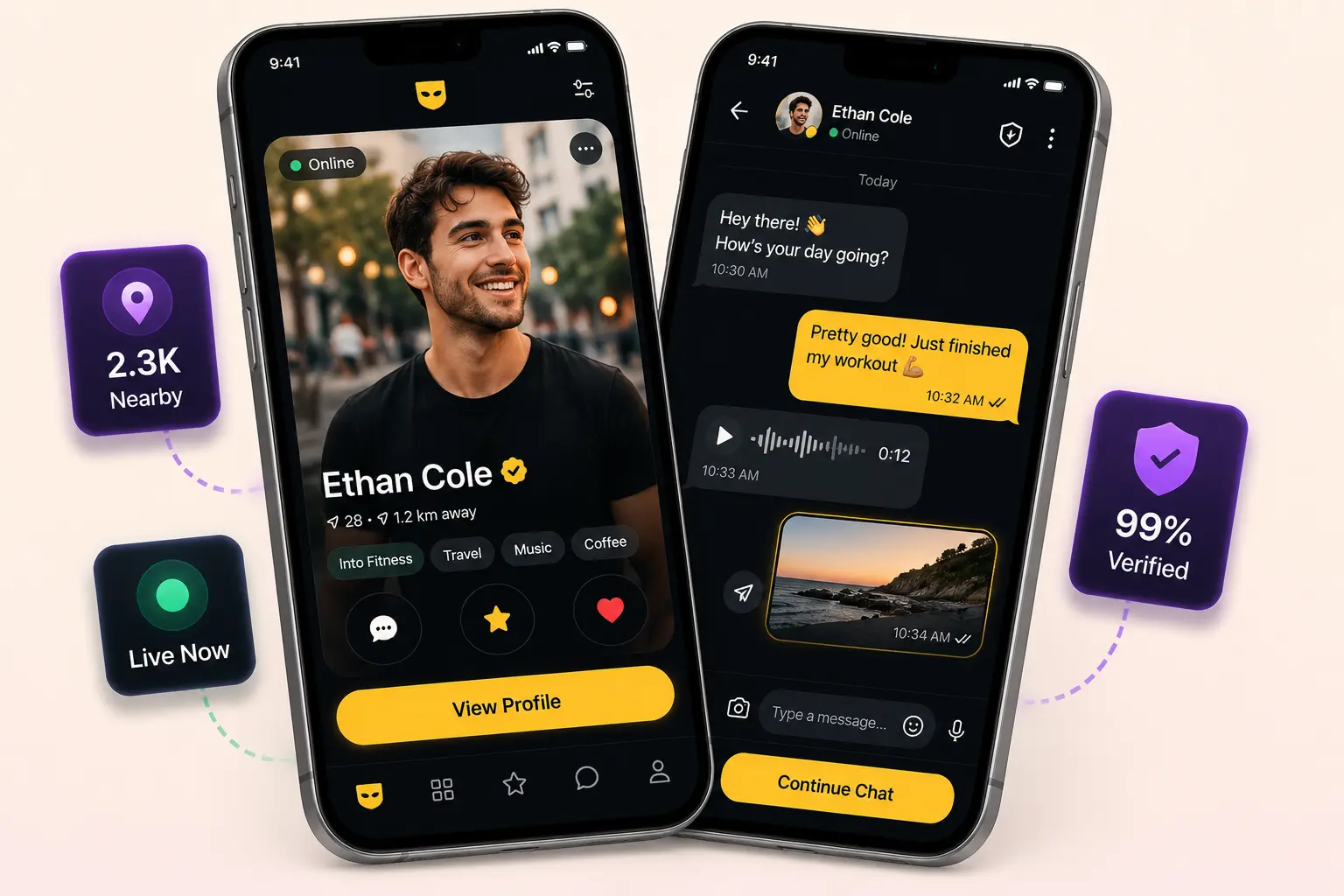
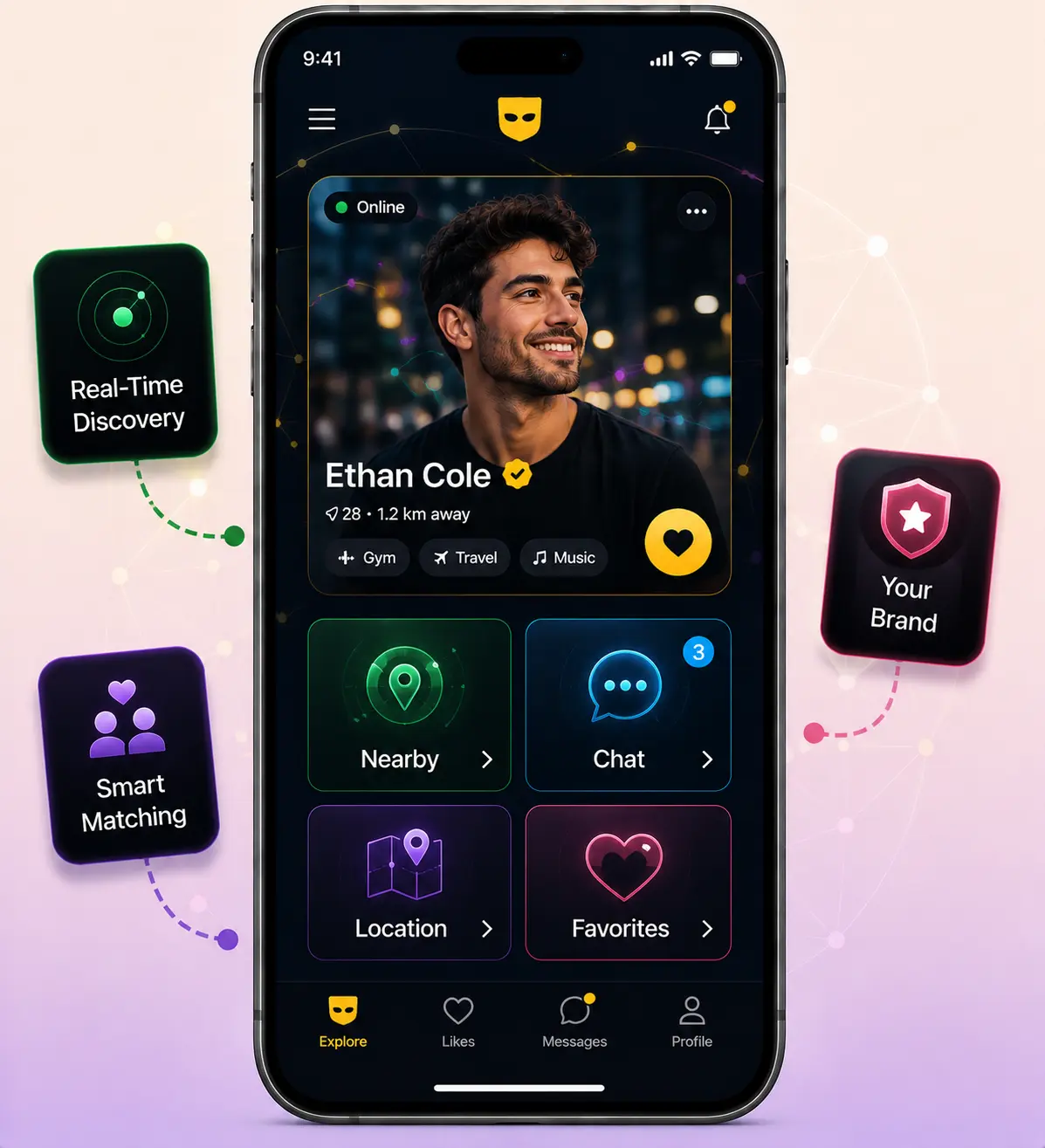
A Grindr clone is a ready-made, location-first dating and social networking app for gay, bi, trans, and queer people. Nearby profiles appear in a distance-sorted grid, users chat privately, and the whole experience is built around who is close right now. Instead of building the grid, real-time chat, geolocation, and the safety architecture from scratch, you launch a proven model under your own brand.
Be precise about the product, because most vendors are not. This is not a swipe app. There are no swipes, rewinds, or super-likes, and any provider offering them on a Grindr clone is selling you a repurposed Tinder script with the labels changed. The grid is the model, and proximity is the matching logic.
Your clone recreates that experience on code you own outright. The difference between a clone script and a white-label rental is ownership. Most providers charge recurring fees while keeping control of your software, your data, and your policies.
With Xpertz, you receive the complete source code, with full ownership, independent hosting, and the freedom to set the markets, the safety defaults, and the data rules on your own terms.
The Grid, Not the Swipe: Why Proximity Won
Grindr launched in 2009 and did something the swipe apps never did. It answered a different question. Not who might you match with eventually, but who is nearby right now. That single design choice built a category, and it is still under-served nearly everywhere outside a handful of large cities.
Here are a few facts that put the opportunity in perspective:
- Grindr is a location-based social networking app for gay, bi, trans, and queer people, launched in 2009
- Regulators assessed it at roughly thirteen point seven million active users, with worldwide turnover approaching one hundred million euros
- Its interface is a proximity-sorted grid rather than a swipe deck, which is why the two products behave nothing alike
- Norway's data regulator fined it sixty five million kroner for sharing user data with advertising partners, and every appeal failed
- The courts held that simply being a user of such an app is sensitive data, because it indicates membership of a sexual minority
Read the last two points together, because they are the opening. The category leader's defining public failure was privacy, on an audience for whom privacy is not a preference but a safety requirement. A platform built privacy-first, with safety controls in the base product and a subscription model that never needs to sell what it knows, competes exactly where the incumbent has been found wanting.
Inside the Build: Grid, Chat, and Safety Controls
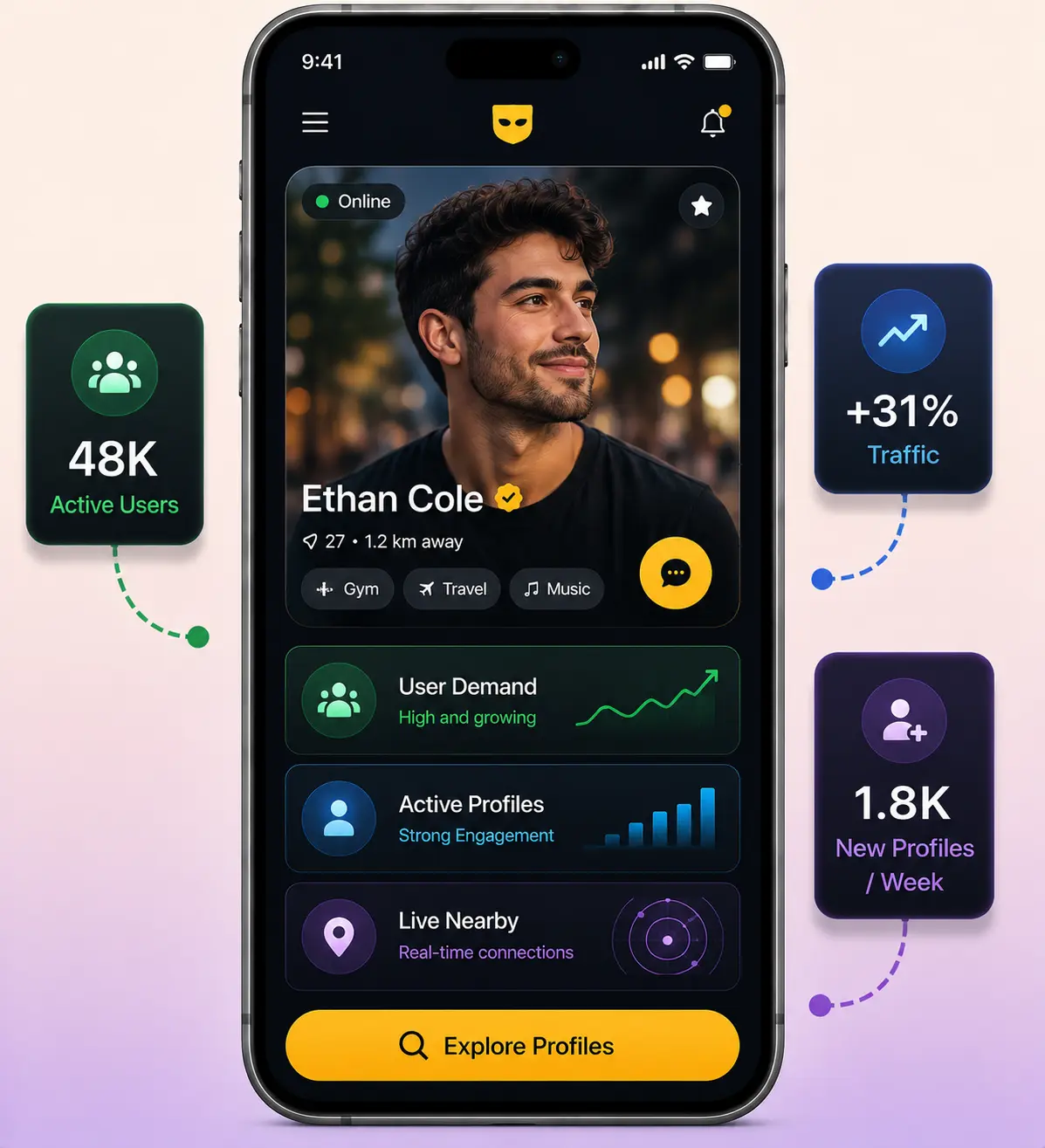
Every feature below ships in the standard Grindr clone build. Not add-ons, not upsells, not a stripped tier. The safety controls are core, because on this platform they are the product.
Proximity Grid
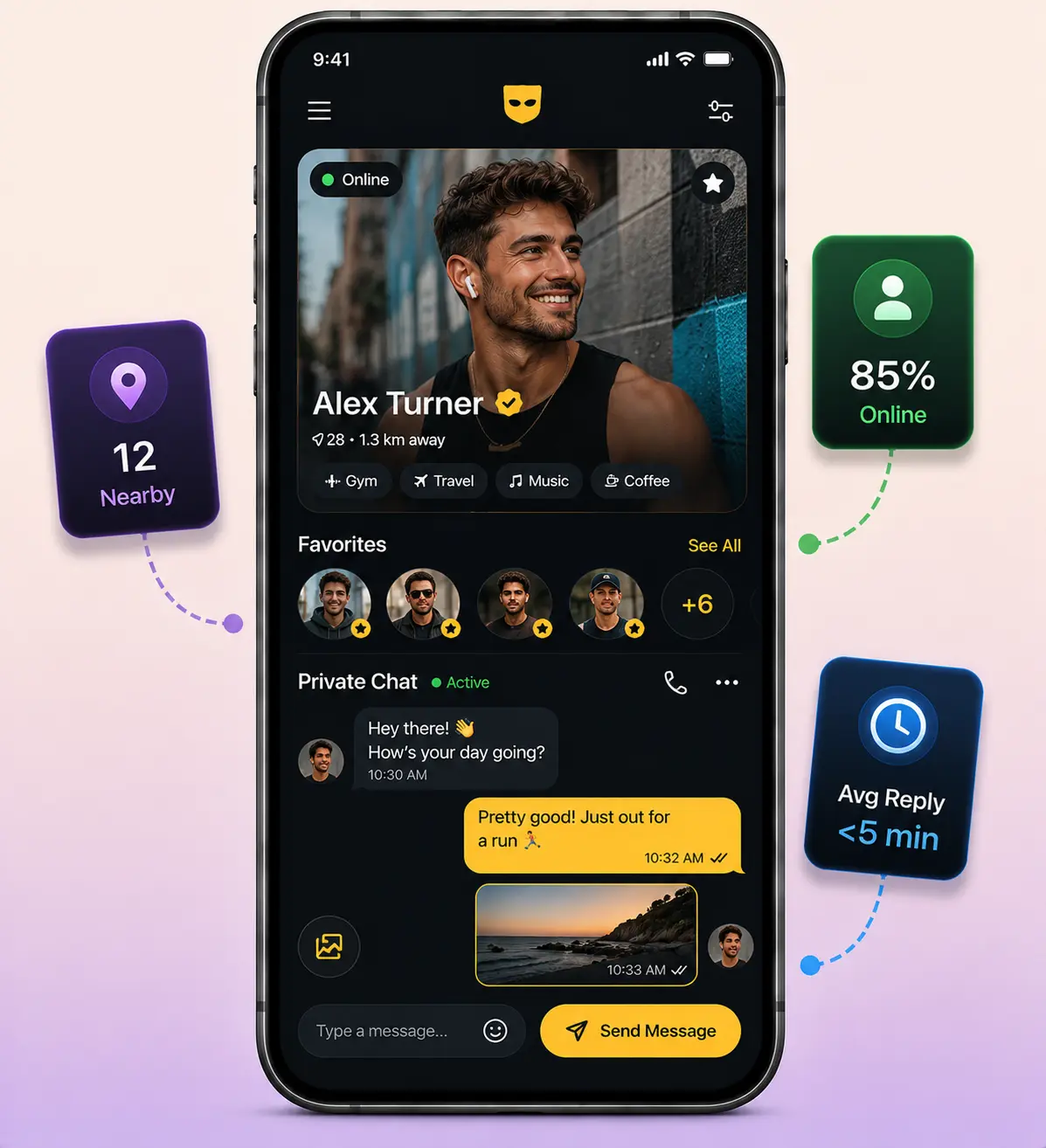
Users see nearby profiles as a distance-sorted grid rather than a swipe deck. The grid is the product, because it answers who is close right now instead of who might match you eventually.
Profiles and Tags
Users describe themselves with tags, interests, and intent, from friendship to dating. Tags let people find compatible company fast without writing a long profile they will never update.
Real-Time Chat
Private chat carries text, photos, voice notes, and location shared only when a user chooses. Everything stays on the platform, so moderation, reporting, and safety tooling all actually work.
Distance Privacy Controls
Users hide their distance, blur precise location, or disable it entirely, and the platform can enforce it. Precise distance can be triangulated, so these controls are safety infrastructure.
Discreet Icon and PIN Lock
The app can wear a neutral icon and name, and open only behind a PIN or biometric lock. In many households and countries an unlocked, obvious icon is a genuine physical risk to the user.
Quick Exit Control
A single tap closes the app and lands the user on a neutral screen if someone looks over. This is a small feature that matters enormously to people who are not out to those around them.
Screenshot Protection
Chats and private albums can block screenshots and flag capture attempts to the other person. Screenshots drive outing, blackmail, and harassment, so the platform treats capture as a safety event.
Photo Verification
Verification confirms a profile belongs to a real person, and verified badges surface in the grid. Verification is the single strongest defense against catfishing, extortion, and entrapment accounts.
Geo-Fencing Controls
You geo-fence the platform by country and region, restricting or hardening the app where users face legal risk. Where you operate is a decision your admin panel enforces, not an accident.
Blocking and Reporting
Users block, mute, and report in one tap, with reports reaching a moderation queue immediately. Fast, visible enforcement is how a community with real safety stakes learns to trust a platform.
Consent-First Data Controls
Users grant or refuse each data use separately, and refusing never blocks access to the app. Bundled take-it-or-leave-it consent is not lawful consent, and this is where the category has been fined.
Private Albums
Users share private photo albums with specific people and revoke access at any time. Selective sharing gives people control over exposure without pushing intimate content into a public profile.
Who This Model Fits, From Founders to Communities
A Grindr clone is not built for one buyer. The proximity-grid model works for community founders, regional operators, and social startups where nearness matters more than matching.
LGBTQ Community Founders
You want to build a safer, better-run social app for a community you belong to and actually understand.
Regional Founders
You serve a country or language market where global apps have poor moderation, wrong defaults, or no local support.
Niche Community Builders
You focus on a specific community, subculture, or interest where a general app feels crowded and impersonal.
Established Dating Brands
You already run a dating product and want a location-first, community-specific vertical under a separate brand.
Social Networking Startups
You want a proximity-based social app, and dating is one use case for the grid rather than the only one.
Investors
You want a launch-ready platform in a proven, subscription-led model rather than a multi-month build from zero.
Six Stages From Scope to a Live Dating App
Our build process is structured and transparent. Six clear stages take your Grindr clone from scope to launch, tested, documented, and delivered on the schedule we agree.
Discovery and Requirements
We start with a detailed conversation about your community, launch markets, safety defaults, monetization, and timeline, and produce a written scope you approve before any work begins.
Planning and Architecture
Our team designs the grid, geolocation, chat, and consent systems, with privacy architecture and infrastructure sized for your expected scale, and a milestone timeline mapped before development starts.
UI/UX Design
Custom interface design applied to your brand. The grid, the chat experience, the safety controls, and the admin panel are designed and approved before development starts.
Development and Integration
We build the platform and integrate the proximity grid, real-time chat, verification, moderation tooling, geo-fencing, billing, and the consent layer. You have staging access throughout to review progress.
Testing and Quality Assurance
Comprehensive testing across the grid, chat, location privacy, moderation, and billing on iOS and Android, plus security, penetration, and privacy checks before anything goes live.
Deployment and Handoff
Full source code delivery, app store submission, deployment to your server, an admin panel walkthrough, and six months of free post-launch support starting from handoff.
How the Platform Earns Without Selling User Data
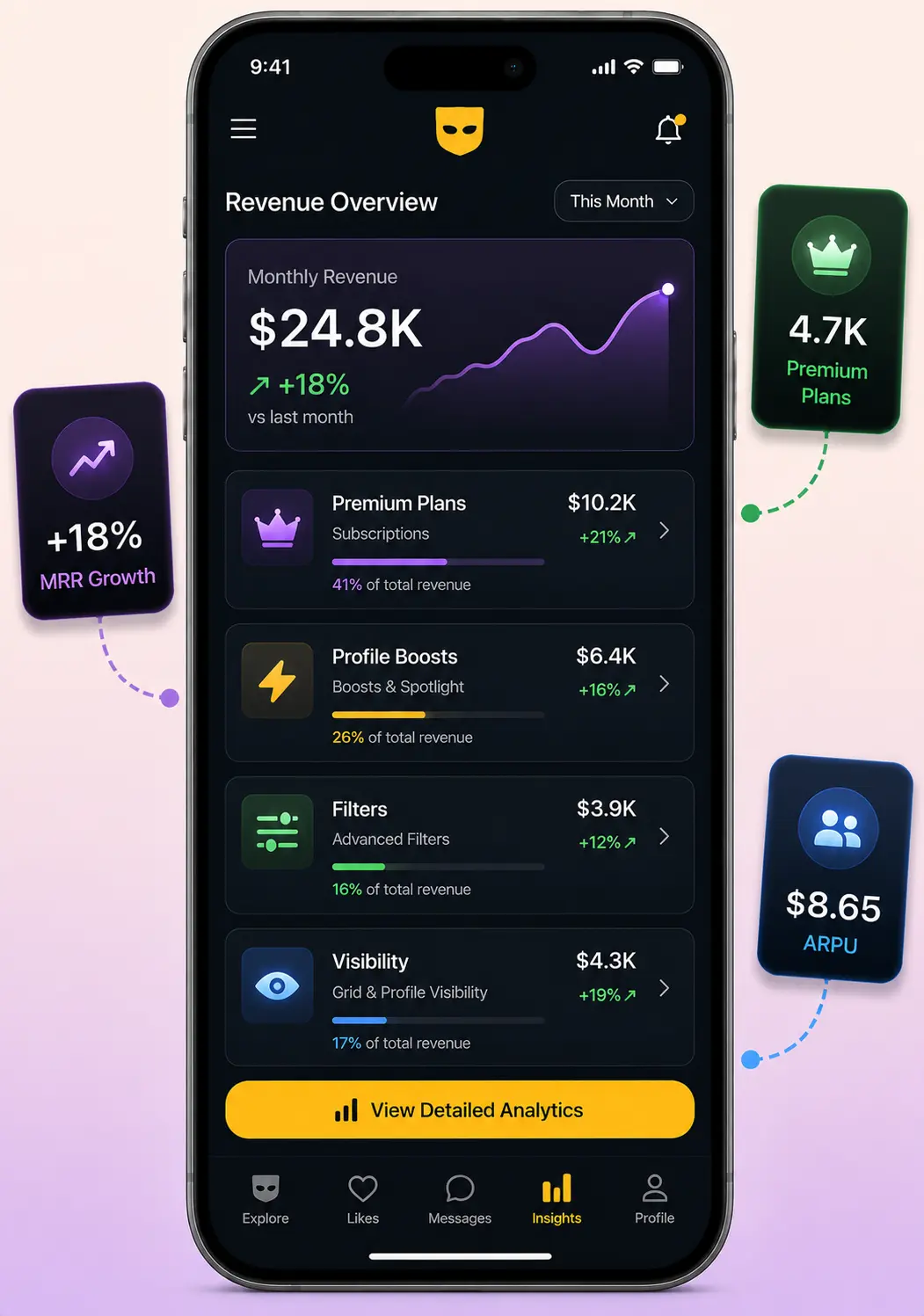
A location-first social app earns from subscriptions and upgrades, not from selling what it knows. Here are the monetization models in our Grindr clone build, set from your admin panel.
Premium Subscriptions
Sell a recurring tier that unlocks unlimited profiles, advanced filters, and read receipts. Subscriptions are the durable revenue base here, and unlike advertising they never require selling user data.
Boosts and Spotlight
Users buy one-off boosts that lift their profile to the top of the nearby grid for a set window. A high-intent impulse purchase that stacks on subscriptions and scales with engagement, not headcount.
Ad-Free Tiers
Charge a premium for an entirely ad-free experience, which this privacy-conscious audience values highly. Selling the absence of tracking is a legitimate product, and a strong one in this category.
Contextual Advertising
If you run ads, run contextual ones keyed to the app rather than to a user profile. Behavioral targeting on this audience is a legal minefield, and the section below explains exactly why it is.
Travel Mode
Users pay to browse and connect in a city before they arrive, which is a genuine need for this audience. It monetizes travel intent without needing any additional data collection whatsoever.
Community Partnerships
Partner with venues, events, and brands on sponsored placements agreed at the platform level. Revenue that never touches individual user data or their sensitive personal attributes at all.
The Stack Behind Our Grindr Clone Script
We build on standard, well-documented technologies. Any developer can read the code, extend it, and maintain it without a proprietary framework learning curve.
React Native
Kotlin
Node.js
NestJS
PostgreSQL
PostGIS
Redis
WebSockets
Socket.IO
Stripe
AWS S3
CDN
Is a Grindr Clone Profitable?
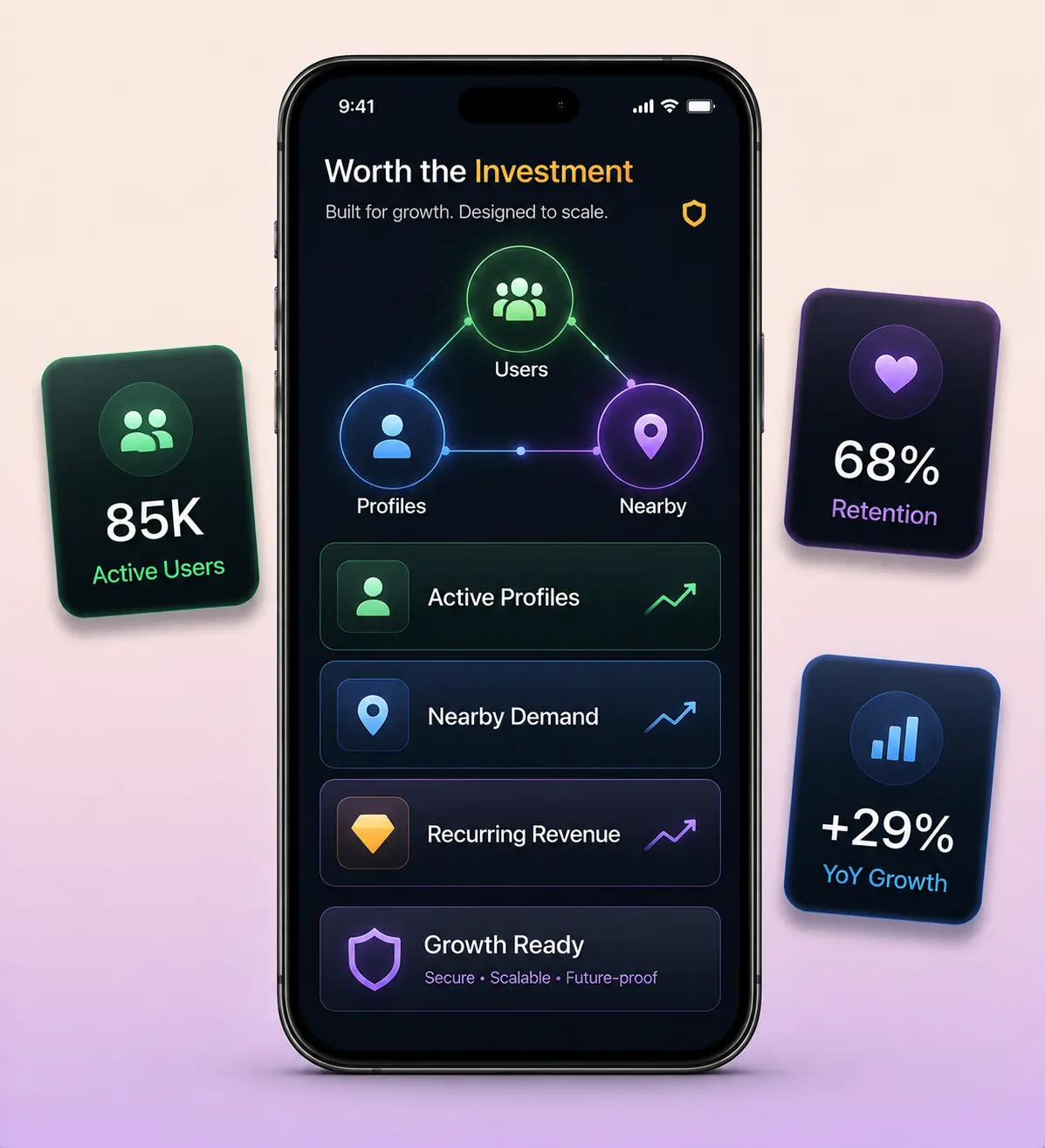
Yes, and the model is unusually clean: a subscription-led social app with no inventory, no supply side to recruit, and high margins once density exists. But three things decide it, and only one of them is software.
Three things drive whether your platform works:
- Where you operate: In the many countries where same-sex relationships remain criminalized, this app can expose users to entrapment, arrest, or violence. Geo-fencing, hardened defaults, and an honest decision about which markets you serve are business strategy, not a settings screen.
- How you monetize: Behavioral advertising on this audience is a legal minefield that produced the largest privacy fine in Norwegian history. Subscriptions, boosts, ad-free tiers, and contextual placements earn well and never require selling sensitive data.
- Local density: A proximity app with nobody nearby is useless. Winning one city completely beats a thin presence across a country, so launch city by city and prove liquidity before you widen.
A professionally built platform removes the technical failure points. The rest is execution on geography, monetization, and density.
Subscriptions, In-App Billing, and Ad-Free Tiers
Unlike explicit adult platforms, this app is permitted on the mainstream app stores, which changes the billing picture entirely. Mainstream processors work, and store rules apply.
Apple App Store and Google Play Billing
Premium tiers and boosts sell through Apple and Google in-app billing on mobile, where nearly all of your users are. Store fees are planned into pricing from the start.
Stripe and Local Methods on Web
Web purchases run through Stripe with local payment methods for your markets, which lets users avoid store fees and improves your margin where they do.
Discreet Billing Descriptors
Charges appear under neutral descriptors so a shared bank statement never outs anyone. On this platform that is a safety feature, not a courtesy.
Complete Feature Set for Users
The user experience decides whether people feel safe enough to stay, and safety and product are the same thing here. Here is the full feature set for users on your Grindr clone.
Browse the Grid
Users see nearby profiles sorted by distance in a live grid, filtered by the tags, intent, and interests they care about.
Control Their Distance
Users hide distance, blur their precise location, or turn location off entirely, and the platform respects that setting.
Lock the App Down
Users switch to a discreet app icon and require a PIN or a biometric unlock before the app will open on their device.
Exit Instantly
Users tap once to close the app and land on a neutral screen, so a glance over their shoulder never reveals anything.
Chat Privately
Users message with text, photos, and voice notes, with screenshot protection and capture alerts on any private content.
Share Private Albums
Users share private photo albums with chosen people only, and can revoke that access again at any moment they choose.
Verify Themselves
Users complete photo verification to earn a badge that proves they are real, which lifts replies across the platform.
Block and Report
Users block, mute, and report anyone in a single tap, and every report reaches a live moderation queue almost instantly.
Choose Their Data Uses
Users approve or refuse each use of their data separately, and refusing anything never restricts their access to the app.
Subscribe or Boost
Users upgrade to a premium tier or buy a one-off boost, paying through the app stores or through your own web gateway.
Complete Feature Set for Admin
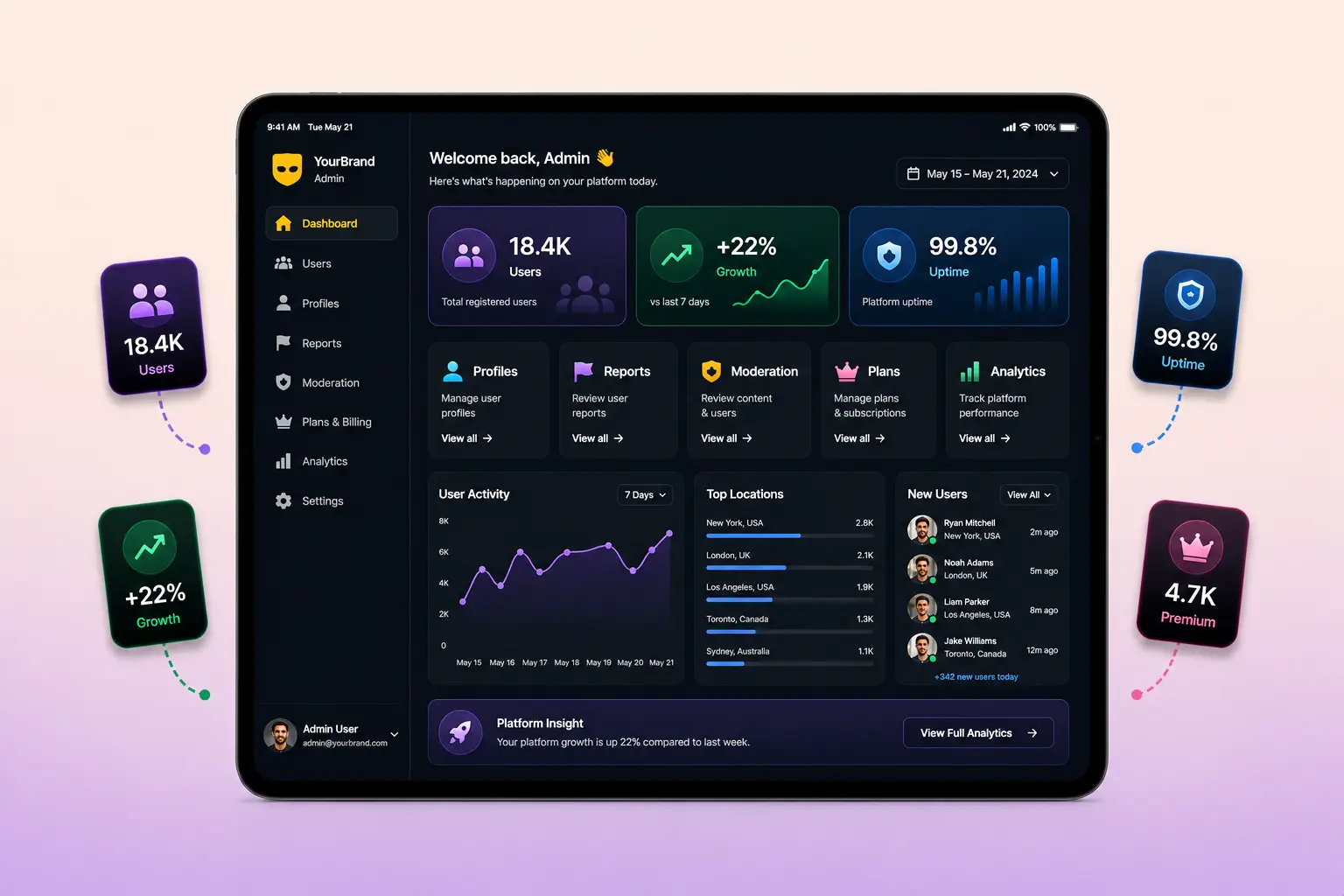
The admin dashboard is how you run the platform without developer involvement. Every core operation, including geo-fencing, consent, and safety escalation, is covered from one panel.
Verification Queue
Review photo verification submissions and approve, reject, or escalate accounts before they earn a visible trust badge.
Moderation Tools
Work reports, chats, and images in a real-time queue with bulk actions, built for the volume a live social app produces.
Geo-Fencing Controls
Restrict, harden, or disable the app by country and region, with safety defaults enforced automatically in higher-risk markets.
Consent Management
Configure granular, unbundled consent for every data use, with full audit records, and never gate app access behind consent.
Data Retention Rules
Set retention windows and honor deletion requests properly, so user data never outlives the purpose it was collected for.
Subscription and Billing
Configure premium tiers, boosts, and pricing for each market, across app-store billing and your own web payment gateway.
Advertising Policy
Control which ad partners run and enforce contextual-only serving, blocking behavioral targeting at the platform level.
Grid and Discovery
Tune ranking, distance bands, and filters that decide who appears in the grid and how visible any given profile becomes.
Safety Escalation
Flag extortion, entrapment, and harassment patterns for human review, with a defined path to law enforcement where safe.
Analytics Dashboard
Track users, retention, subscriptions, and revenue in real time, with reporting that never exposes individual profile data.
Optional AI Add-Ons, Scoped After Launch
These AI capabilities are optional add-ons, not part of the standard MVP build. We layer them in as a customizable extra once your core platform is live.
AI Image Moderation
Screens uploads for prohibited content, minors, and non-consensual imagery before anything reaches the grid. The highest-priority add-on on any platform of this kind.
AI Extortion and Entrapment Detection
Flags sextortion scripts, blackmail patterns, and coordinated fake-profile behavior in chat. On this platform these are physical safety threats, not spam.
AI Photo Verification
Automates liveness and face-match checks during onboarding so verification scales without a review team growing alongside it.
AI Fake-Profile Detection
Identifies duplicate, automated, and impersonation accounts before they reach users. Real profiles are the foundation of trust in a proximity app.
AI Harassment Filtering
Detects abusive and unsolicited content in chat and lets users filter it out automatically, which measurably improves retention among newer users.
AI Support Assistant
Answers common account, billing, and safety questions around the clock, cutting support load as the platform grows.
Why Founders Pick Xpertz for
Dating App Builds
Here is what separates our Grindr clone development service from other companies in this space.
Full Source Code Delivery
You receive the complete codebase at the end of the project. Host it anywhere, modify anything, and hand it to any development team in the future. No vendor lock-in after delivery.
Six Months of Free Support
Post-launch bugs and questions are covered at no extra charge for six months. You get answers and fixes, not a separate support invoice.
Privacy-First Engineering
We build consent, data minimization, and retention rules as architecture rather than paperwork. In this category that is not compliance theater, it is the difference between a business and a fine.
Competitive Pricing
We operate lean. No large overhead, no layers of account management. The savings show up directly in your project quote compared to larger dev shops.
Free Server Installation
We deploy the platform to your server at no additional cost. You do not need a separate technical team to get from build to live.
No Hidden Fees
The quote you receive covers the full project scope. No surprise charges for assumed features or for deployment and launch support.
