

TL;DR: Before Hiring LMS Developers
- The right LMS developer should match the actual scope of your project, whether you need customization, integrations, extensions, or a custom platform.
- Strong LMS development requires more than coding ability; developers should understand learning standards, workflows, integrations, performance, security, and accessibility.
- The best way to assess a developer is to discuss real LMS requirements and understand how they approach technical decisions, exceptions, integrations, and changing requirements.
- Ownership, documentation, maintenance, support, and handover should be settled before signing so your business retains control of the LMS after development ends.
We’ve worked around enough LMS projects to know that the hiring decision can shape the project long after the first release. The issue is not whether a developer can write good code. It is whether they understand the decisions specific to an LMS and can apply that knowledge to your product. A CV will tell you which technologies a developer has used. But, it will not tell you how well they understand LMS requirements, where their judgement comes from, or whether they are suited to the way you plan to build and operate the platform.
That’s why we would not shortlist developers based on portfolios and hourly rates alone. If you are deciding how to hire LMS developers, the following points are the checks we would make before choosing one.
What Kind of LMS Development You Actually Need
Before you hire LMS developers, decide what you actually need them to do. “LMS development” covers different types of work, and hiring against the wrong one can lead to paying for skills your project does not require.
Most projects fall into four categories:
- LMS Configuration & Customization: Setting up an existing LMS, modifying its interface, configuring roles, learning workflows, and connecting it with other business systems.
- Plugin or Module Development: Adding functionality to an existing LMS through custom plugins, activities, reports, dashboards, or administrative tools without rebuilding the core platform.
- LMS Integration Development: Connecting the LMS with HRMS, CRM, SSO/identity providers, payment systems, video platforms, content tools, or other learning applications.
- Custom LMS Development: Building a new platform when existing products cannot support your required workflows, business rules, content delivery model, or integrations. This is often the route for businesses that want a tailored Udemy clone, rather than adapting an existing LMS to fit their requirements.
These are not interchangeable skill sets. A developer who specialises in extending Moodle or another established LMS may not be the right choice for a fully custom platform.
Likewise, bringing in a large custom development team for basic configuration and integrations can add unnecessary cost.
Platform Experience and LMS Product Engineering Are Distinct Skills
Knowing how to work inside an LMS is very different from knowing how to engineer one.
We have seen candidates with strong platform experience who could manage courses, users, permissions, and reports confidently, but struggled when asked what actually happens behind those functions.
For an LMS developer, that deeper understanding matters, particularly around learner progress, assessment rules, certification logic, APIs, integrations, and learning standards.
When you hire LMS developers for a custom build or major customization, we would look beyond the LMS names on their CV and ask what they personally built.
- If they cite course completion, ask how completion was calculated and what conditions triggered it.
- If certifications are part of their experience, ask how expiry, renewal, and eligibility were handled.
- If they highlight integrations, ask how learner data was exchanged, synchronized, and managed between systems.
The platform tells you where they worked; their explanation tells you how deeply they understand LMS development.
Assess Their Knowledge of SCORM, xAPI, cmi5, & LTI Before Their Tech Stack
When you hire LMS developers, their knowledge of learning standards can tell you more about their LMS capability than a long list of programming languages.
A developer working on an LMS should understand SCORM, xAPI, cmi5, & LTI and, more importantly, know where each fits.
- SCORM: Commonly used to package and deliver e-learning content while exchanging data such as completion, scores, and session status with the LMS.
- xAPI: Designed to record learning activity across different environments, including apps, simulations, mobile experiences, and activities outside the LMS.
- cmi5: Uses xAPI with defined rules for launching and managing learning content through an LMS.
- LTI: Connects an LMS with external learning applications such as assessment tools, virtual classrooms, and other educational services.
Do not ask candidates to simply define these standards. Give them a real requirement and ask which standard they would use and why. Their reasoning is a much better measure of LMS expertise than their tech stack.
Ensure They Understand LMS Workflows, Not Just Features
A developer may know how to build courses, assessments, certificates, and notifications. What matters is whether they understand how these features work together.
For example, a learner may need to complete one course before accessing another, pass an assessment to receive a certificate, or renew that certificate after a set period.
These kinds of connected learning workflows are especially important when building platforms such as an Unacademy Clone, where course progression and assessments need to work together throughout the learner journey.
When you hire LMS developers, give them a real workflow from your business and ask how they would handle it. Ask what triggers each step, what information needs to be recorded, and what happens if a learner does not follow the expected path.
This gives you a much better view of their LMS knowledge than simply asking which features they have built.
Evaluate How They Approach LMS Integrations and Interoperability
An LMS often needs to connect with other systems, such as an HRIS, CRM, identity provider, payment gateway, video platform, assessment tool, or proctoring service.
The important question is not just whether a developer can connect two systems. It is whether they know how to keep the data accurate when something changes or a connection fails.
When you hire dedicated LMS developers, ask about their approach to SSO, APIs, data synchronization, webhooks, and error handling. Give them a simple scenario like, an employee is added to the HR system, but the LMS does not create the learner account. What happens next?
A good developer should be able to explain how the issue is detected, retried, recorded, and resolved. That tells you much more about their integration skills than simply asking, “Can you integrate this system?”
Ask How They Would Design the LMS for Scalability and Performance
An LMS may work well with a few hundred users and behave very differently when thousands of learners log in, stream courses, or take assessments at the same time. Compliance deadlines, employee onboarding, and large training programs can create sudden spikes in usage.
When hiring LMS developers, ask how they would prepare for concurrent users, video delivery, large course files, database activity, and reporting. Also ask how they would test performance before launch and monitor it as usage increases.
You do not need a developer who simply says, “We can add more servers.” Ask what they expect to become a bottleneck as the number of learners grows and how they would identify the issue.
Their answer should show that performance has been considered as part of the LMS design, not left for users to discover later.
Prioritize Security, Permissions, and Learner Data
An LMS can hold learner profiles, employee details, assessment results, certifications, training records, and payment information. How that data is accessed and managed should be considered while the platform is being built, not added as a final security check.
Depending on your users, location, and industry, requirements such as GDPR, FERPA, or HIPAA may also apply.
When you hire LMS developers, ask how they would manage permissions for learners, instructors, managers, and administrators. Go beyond the interface like permissions should also be enforced across APIs, reports, exports, and stored records.
Ask how sensitive data is protected, how administrative activity is logged, and how access is removed when a user’s role changes.
A developer who understands LMS security should be able to discuss these areas clearly without treating security as an afterthought.
Evaluate Their Understanding of LMS Accessibility and Inclusive Design
An LMS may look easy to use while still creating problems for learners who rely on keyboard navigation, screen readers, captions, transcripts, or other assistive technologies.
WCAG 2.2 is the current reference point for web accessibility, and accessibility requirements may also matter for your contracts, industry, or region.
When hiring LMS developers, ask how they have handled accessibility in an actual LMS. Discuss keyboard navigation, focus states, screen readers, accessible forms and assessments, captions, transcripts, timed tests, and interactive course content.
Do not rely only on just what they say, instead, test a product they have built using a keyboard. Check whether you can navigate the main functions, complete an assessment, and access the learning content without a mouse.
Accessibility should be visible in the product, not just listed in the developer’s proposal.
Decide Between a Freelancer, Dedicated LMS Developer, or Full Development Team
There is no single right way to staff an LMS project. The choice depends on what you need built, how long the development will continue, and who will own the platform after launch.
- Freelancer: Suitable for defined work such as a plugin, SCORM migration, reporting change, or specific integration.
- Dedicated LMS Developer: A better fit when the LMS needs regular development, maintenance, integrations, and feature updates without requiring a complete team.
- Full Development Team: Makes sense for a custom LMS where frontend, backend, UI/UX, QA, integrations, and other work need to move in parallel.
When you hire LMS developers, consider what happens after the first release. Who handles updates, fixes, integrations, testing, and new requirements?
Choose the hiring model based on the work your LMS will require over its lifecycle, not simply the development budget for the initial build.
Key Questions to Ask Before Hiring an LMS Developer
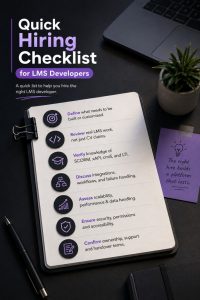
Once you have shortlisted developers, use the interview to find out what they have actually built and how they approach decisions. Avoid questions that can be answered with a simple “yes.”
- Which LMS products have you taken to production? Ask what they personally handled and request a live example where possible.
- Which learning standards have you implemented? Ask about SCORM, xAPI, cmi5, or LTI and why each was used.
- How do you handle course versioning? Especially when content changes while learners are already enrolled.
- How do you test LMS performance? Ask what they test and how they identify bottlenecks.
- How do you manage roles & permissions? Ask how access is controlled across the LMS, APIs, reports, and exports.
- How do you handle AI features? If your LMS will use AI for recommendations, content generation, assessments, tutoring, or learner support, ask which models or services they have integrated and how they handle accuracy, data privacy, and human review.
- What happens when an integration fails? Look for clear answers around logging, retries, and data reconciliation.
- Who owns the code and documentation? Clarify repository access, intellectual property, credentials, and handover terms.
The point of these questions is not to test how many LMS terms a developer knows. You are trying to understand how they think, what they have actually owned, and whether you would trust them with your LMS once development gets underway.
Red Flags to Watch for When Hiring LMS Developers
When we interview LMS developers, we pay as much attention to what they cannot explain as what they put on their CV. A long list of LMS platforms and technologies means very little if the conversation falls apart when you ask about an actual implementation.
These are the signals we take seriously:
- Terminology Without Depth: If SCORM, xAPI, cmi5, or LTI appears on their profile, ask where and why they used it.
- Unclear Contribution: Ask what they personally designed, developed, tested, and maintained.
- Weak Technical Reasoning: They should be able to explain the approach they chose, the alternatives considered, and the trade-offs.
- Security Comes Later: Learner data, permissions, authentication, and access controls should be part of the LMS discussion.
- Poor Handover: Source code, documentation, repositories, credentials, and deployment knowledge should not depend on one developer.
- Premature Estimates: A reliable cost and timeline should follow a proper discussion of workflows, integrations, users, content, reporting, and scope.
One unanswered question is not a reason to reject a developer, but a consistent lack of depth is. If the answers remain vague while the estimates remain confident, we would think twice before making the hire.
Clarify Code Ownership, Documentation, Maintenance, and Support Before Signing
The hiring decision does not end when development is complete. Before signing, be clear about what your business will own, receive, and control once the developer is no longer working on the LMS.
- Code Ownership: Confirm ownership of the source code, custom modules, integrations, databases, and project-specific work.
- Documentation: Define what you will receive, including setup guides, API documentation, data flows, deployment instructions, and admin documentation.
- Maintenance: Clarify who handles bugs, security updates, dependencies, compatibility issues, and changes to LMS standards.
- Support: Agree on response times for critical issues, routine fixes, and enhancement requests.
- Handover: Ensure your team receives repository access, credentials, deployment details, documentation, and other required assets.
These terms are easy to overlook while discussing features and budgets. They become important when you need to change developers, troubleshoot a production issue, or take control of the LMS yourself.
If ownership and handover cannot be discussed clearly before signing, we would treat that as a serious concern.
Make the Hire With the Bigger Picture in Mind
The developer you choose will influence how your LMS performs, evolves, and is maintained long after the initial build. That makes the hiring decision bigger than comparing portfolios or development rates. Look at how candidates think through real LMS requirements, explain their decisions, and take ownership of their work. Be equally clear about code ownership, documentation, support, and handover before signing. If you are ready to hire LMS developers, choose the person or team you would trust to stay accountable for the product, not simply the one that promises to build it.
FAQs About How to Hire LMS Developers
1. What should an LMS developer know about multi-tenant LMS requirements?
If different organizations will use the same platform, ask how they would separate users, courses, reports, branding, permissions, and administrative access between tenants. Data separation should be clearly addressed.
2. What AI capabilities should an LMS developer be able to implement?
An LMS developer should understand how to integrate AI-powered recommendations, virtual tutors, content generation, assessment assistance, semantic search, and learning analytics while maintaining security and data controls.
3. What indicates that an LMS developer is suitable for long-term engagement?
Look at how they document decisions, communicate technical limitations, respond to changing requirements, and transfer knowledge. Their working process often reveals more about long-term suitability than the initial proposal.