

TL;DR: Hotel Booking App Development
- Hotel booking app development starts with choosing the right business model, whether you are building an OTA, direct hotel booking app, aggregator, or niche platform.
- Core features include real-time hotel availability, search and filters, room selection, secure payments, booking management, cancellations, partner tools, and admin controls.
- Hotel booking app development cost ranges from $25,000 – $400,000+, with around $10,000 – $30,000 in annual ongoing costs for hosting, APIs, maintenance, security, and updates.
- Choosing the right hotel booking app development company requires evaluating hospitality expertise, integrations, support, pricing, and product experience. Xpertz.io offers both custom and ready-made hotel booking app solutions.
Mobile is now a major booking channel, making hotel booking app development a strategic opportunity for hotels, OTAs, and travel-tech businesses.
Booking.com reported a high-fifties percentage of room nights through mobile apps in Q1 2026, while Airbnb generated 63% of its nights booked through its app, and Trip.com reported more than 70% of bookings through mobile.
A successful app goes beyond property search. It should support real-time availability, room selection, payments, cancellations, and booking management within a smooth mobile experience.
This guide covers essential features, the development process, technology considerations, hotel booking app development cost, and how to choose the right hotel booking app development company.
How Does a Hotel Booking App Work?
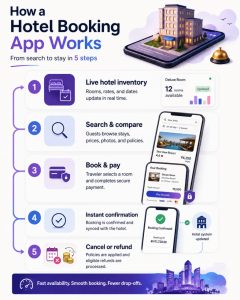
Underneath the clean search bar and photo carousels, a hotel booking app is really a real-time coordination layer between travelers, individual properties, and payment rails. Every booking, at its core, moves through five stages.
1. Hotel Inventory & Availability
Each property feeds its room types, rates, and open dates into the app, either manually through a partner dashboard or automatically via a property management system connection. This data has to stay current to the minute, or you end up selling rooms that are already gone.
2. Search and Room Selection
Guests enter a destination, dates, and guest count. The app retrieves matching properties and displays prices, room types, amenities, policies, ratings, and photos for comparison.
3. Booking and Payment
After selecting a room and rate plan, the guest enters their details and completes payment through an integrated payment gateway. The system then creates the reservation and records the selected rate and cancellation terms.
4. Confirmation and Reservation Sync
The hotel booking app generates a booking reference and sends confirmation through email, SMS, or push notification. The reservation is also passed to the hotel’s system so staff can access the latest booking information.
5. Cancellation and Refund
If a guest cancels, the app applies the property’s cancellation policy, calculates any applicable charges, updates the reservation, and processes the refund when eligible.
For businesses investing in hotel booking app development, every second in the booking journey matters. If room availability is outdated or confirmation takes too long, customers may drop off before completing the reservation or book with a competitor.
Types of Hotel Booking Apps
The first decision in hotel booking app development is not the feature list. It is deciding what kind of booking business you are building. An OTA serving thousands of properties has very different requirements from a hotel chain trying to increase direct reservations.
Here are the main models, with real-world examples.
1. OTA Hotel Booking Apps
Examples: Booking.com, Agoda, Expedia
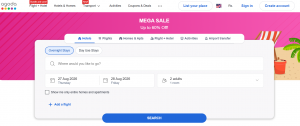
OTAs bring properties from different brands and locations into one marketplace. Their value comes from selection, price comparison, reviews, loyalty programs, and a smooth booking experience. A platform like Booking.com can serve everything from independent hotels to major international chains, making search, ranking, availability, and reservation management central to the product.
2. Hotel Chain & Direct Booking Apps
Examples: Marriott Bonvoy, Hilton Honors, IHG One Rewards

These apps are built around a single hotel group rather than a multi-property marketplace. The goal is to give existing and potential guests a reason to book directly. Features such as member-only rates, loyalty rewards, digital check-in, room upgrades, and mobile key access can become more important than broad property discovery.
3. Hotel Aggregator Apps
Examples: HotelsCombined, trivago
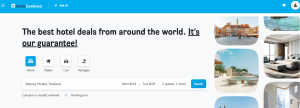
Aggregators focus on comparing accommodation prices across multiple booking sources. Instead of functioning like a traditional hotel marketplace, they help travelers identify where a particular room or rate is available at the best price, often redirecting the user to another booking platform to complete the reservation.
4. Niche Hotel Booking Apps
Examples: Tablet Hotels for design-led stays; Plum Guide for high-end homes

Niche platforms win by serving a specific traveler rather than trying to list everything. A luxury-focused product may prioritize curated properties and personalized service, while a business accommodation platform may need corporate billing, traveler profiles, expense controls, and company-level booking policies.
Other viable niches include resorts, boutique hotels, pet-friendly stays, extended-stay accommodation, wellness retreats, and accessible hotels. In these models, the booking flow is shaped around what matters most to that particular traveler, for example, monthly rates for extended stays or pet policies for pet-friendly accommodation.
Choosing the right model early has a direct impact on hotel booking app development cost, integrations, revenue model, and the features your product actually needs.
Essential Features of a Hotel Booking App Development
A booking app has three distinct audiences, and each needs its own set of tools working in sync.
Features for Travelers
| Features | What It Should Include | Why It Matters |
| Account & Profile Management | Email/phone signup, social login, saved traveler details, preferences | Speeds up repeat bookings and reduces friction at checkout |
| Destination Search | Autocomplete, recent searches, location suggestions, nearby properties | Gets travelers to relevant properties faster, especially when they are unsure of the exact hotel |
| Date, Guest, & Room Selection | Check-in/out, adults, children, multiple rooms, occupancy rules | Ensures search results reflect the traveler’s actual stay requirements |
| Advanced Search & Filters | Price, star rating, property type, amenities, guest score, cancellation policy | Helps travelers narrow hundreds of properties to a shortlist that fits their priorities |
| Map-Based Discovery | Interactive maps, neighborhood search, distance and location pins | Useful for travelers choosing hotels by area rather than property name |
| Hotel & Room Pages | Room size, bed type, occupancy, views, policies, availability | Gives travelers the information needed to make a booking decision |
| Photos & Virtual Content | Property galleries, room images, videos and 360° views where available | Sets expectations before payment and can improve booking confidence |
| Real-Time Availability & Pricing | Live inventory, current rates, restrictions and room-level availability | Prevents stale listings, failed bookings and price discrepancies |
| Reviews & Ratings | Verified stays, rating breakdowns, review filters and property responses | Provides social proof and helps travelers assess properties beyond marketing content |
| Wishlist & Saved Hotels | Save properties, rooms and searches | Lets travelers save hotels for future trips or return visits. |
| Secure Checkout | Guest details, payment methods, taxes, fees, promo codes and booking summary | Keeps the final conversion step transparent and predictable |
| Booking Management | Confirmation, itinerary, booking history, modifications and cancellation | Gives guests control over their reservations without depending on customer support |
| Notifications | Booking confirmation, reminders, price changes, cancellation updates and check-in prompts | Keeps travelers informed about changes that can affect their stay |
| Customer Support | In-app chat, ticketing, FAQs and escalation to human support | Provides a clear resolution path when payment, booking, cancellation or hotel-related issues arise. |
Features for Hotels and Property Partners
| Features | What It Should Include | Why It Matters |
| Hotel Onboarding | Property registration, KYC/document verification, contracts and approval status | Gets verified properties live while maintaining listing quality |
| Property Profile Management | Property information, photos, amenities, policies, location and contact details | Keeps listing information accurate and helps properties attract the right guests |
| Room & Inventory Management | Room types, occupancy, inventory counts, blackout dates and restrictions | Gives hotels control over what rooms can be sold and when |
| Rate Management | Standard, seasonal, weekend, corporate and promotional rates | Lets properties adjust pricing to match demand and maximize room revenue |
| PMS/Channel Manager Integration | Availability, rates and reservations synced with hotel systems | Reduces manual updates and helps prevent double bookings |
| Reservation Dashboard | Upcoming stays, modifications, cancellations, guest details and booking status | Gives hotel staff a clear view of every reservation and upcoming stay |
| Offer Management | Discounts, packages, early-bird rates, last-minute deals and date-based promotions | Helps properties attract demand during slower periods and improve occupancy |
| Cancellation & Refund Rules | Flexible, non-refundable and custom policies with applicable penalties | Ensures cancellation terms are applied consistently across bookings |
| Commission & Earnings | Booking value, platform commission, taxes, adjustments and payout status | Shows properties exactly how much they earn from bookings through the platform |
| Guest Communication | Booking messages, special requests and pre-arrival communication | Helps hotels prepare for guest requirements and deliver a smoother stay |
| Review Management | Review monitoring, responses and feedback insights | Gives properties an opportunity to protect their reputation and address recurring issues |
| Performance Analytics | Occupancy, ADR, bookings, revenue, cancellations and conversion | Helps hotel owners identify what is selling, where demand is changing, and where revenue can improve |
| Payout Management | Settlement schedules, payout history and transaction reconciliation | Makes partner payments easier to track and reduces disputes over settlements |
Features for Platform Admins
The admin panel acts as the control center for the hotel booking platform, giving internal teams visibility across day-to-day operations and business performance.
It should support user and property approvals, booking oversight, commission configuration, payment tracking, refunds, promotions, and review moderation without requiring teams to manage each function separately.
A strong admin dashboard should also provide real-time reporting on bookings, revenue, conversion, cancellations, property performance, and customer activity.
Role-based access can ensure finance, support, operations, and management teams only access the functions relevant to their responsibilities. Integrated support tools can connect customer issues with booking records, while audit logs provide a record of important administrative actions. Together, these capabilities give the business tighter control as booking volume and partner activity increase.
Advanced Hotel Booking App Features
Once the core booking journey works reliably, advanced features can make a hotel booking app more relevant, convenient, and commercially effective. The right additions depend on the target market and business model rather than simply adding every available technology.
- AI-Powered Recommendations: Use booking history, searches, preferences, and behavior to surface properties that are more relevant to each traveler.
- Personalized Search: Adjust property rankings based on traveler preferences, previous interactions, location, and booking patterns instead of presenting identical results to every user.
- AI Customer Support: AI assistants can answer common questions about hotel policies, reservations, amenities, and changes while routing complex cases to support teams.
- Dynamic Pricing: Connect pricing rules to demand, seasonality, occupancy, and inventory levels so hotels can respond to changing market conditions.
- Natural-Language Search: Let travelers search conversationally, such as “quiet hotel near the beach under $150,” instead of relying entirely on traditional filters.
- Multi-Language & Multi-Currency Support: Support local languages, currencies, taxes, and payment preferences when expanding across international markets.
- Loyalty & Rewards: Offer member pricing, points, upgrades, or exclusive benefits to encourage repeat and direct bookings.
- Mobile Check-In & Digital Keys: Allow guests to complete pre-arrival steps and access eligible rooms through their phones. Hilton Digital Key demonstrates how mobile check-in and room access can work together.
- Location-Based Recommendations: Recommend nearby restaurants, attractions, transportation, and hotel services based on the guest’s location and stay dates.
Important Hotel Booking App Integrations
A hotel booking app depends on several external systems to keep availability, pricing, reservations, and payments accurate. The integrations you need will depend on whether you are building a direct hotel app, OTA, aggregator, or marketplace.
- Property Management Systems (PMS): Sync room inventory, rates, reservations, and property data with the hotel’s existing system. Oracle Hospitality & Cloudbeds are examples of PMS platforms used by hotels.
- Channel Managers: Update room availability and rates across multiple booking channels, reducing manual work and double-booking risks. SiteMinder is a widely used example.
- Hotel & Supplier APIs: Provide access to property listings, room rates, availability, and reservation data for OTA and aggregator platforms.
- Maps & Geolocation APIs: Support location-based hotel search, maps, distance calculations, and nearby-place discovery. Google Maps Platform is commonly used for these capabilities.
- Payment Gateways: Handle card payments, digital wallets, refunds, and multiple currencies. Stripe & Adyen are examples worth considering based on your target markets.
- Email, SMS & Push Services: Send booking confirmations, reminders, cancellation updates, and promotional notifications.
- CRM & Customer Support: Connect guest profiles, booking history, conversations, and support tickets for more contextual service.
- Analytics Platforms: Track searches, conversion, booking value, cancellations, and customer behavior to guide product and revenue decisions.
Hotel Booking App Development Cost
The hotel booking app development cost depends largely on the product scope, integrations, platforms, and level of automation required. A basic single-property app costs far less than a multi-supplier OTA platform.
| App Type | Typical Cost |
| MVP/Single-Property App | $25k – $60k |
| Mid-Range Booking Platform | $60k – $150,000 |
| Full OTA/Enterprise Platform | $150,000 – $400,000 |
The main cost drivers include Property Management System (PMS) and channel-manager integrations, payment gateways, admin & partner dashboards, platform choice, AI features, and development team location.
Businesses should also budget around $10k – $30k annually for ongoing expenses after launch. This can cover hosting, API usage, maintenance, security updates, bug fixes, and minor feature improvements.
The actual amount will depend on booking volume and the number of third-party services connected to the app. Payment processing is also usage-based; for example, Stripe’s US standard pricing starts at 2.9% + $0.30 per successful domestic card transaction, while international cards incur an additional 1.5% fee .
For larger OTA platforms, ongoing costs can be higher because hotel APIs, supplier connections, payment processing, and usage increase with scale.
How to Choose a Hotel Booking App Development Company?
Choosing a hotel booking app development company is less about finding the team with the longest feature list and more about finding one that understands how hotel bookings actually work. Use these checks before signing a development contract:
Key Considerations for Hiring Hotel Booking App Development Company
- Check Hospitality Experience: Look for experience with PMS, channel managers, booking engines, rate management, and hotel-specific workflows.
- Review Live Products: Ask for working apps and relevant case studies, preferably for a similar model e as an OTA, direct hotel booking app, aggregator, or marketplace.
- Assess Integration Experience: Ask how the team has handled PMS, supplier APIs, payment gateways, maps, and notification services. Integration failures can affect both timelines and booking accuracy.
- Clarify Post-Launch Support: APIs, payment requirements, security updates, and hotel integrations change over time. Confirm what maintenance, monitoring, and support are included after launch.
- Demand Transparent Pricing: Ask for a cost breakdown covering features, integrations, testing, deployment, and post-launch support instead of accepting a single headline estimate.
- Evaluate Product Thinking: The right partner should understand your booking model, identify unnecessary complexity, and recommend features based on business impact.
After assessing potential development partners, compare whether custom hotel booking app development or a ready-made solution makes more sense for your business. Xpertz.io is one option for businesses seeking pre-built hotel booking functionality with room for customization and third-party integrations.
What It Takes to Build a Hotel Booking App?
The hotel booking market is moving toward faster, more connected mobile experiences, but building a successful product requires more than a polished interface. The right booking model, live inventory, reliable integrations, thoughtful features, and a sustainable cost structure all matter. Whether you are launching an OTA, direct booking platform, or niche marketplace, define the business model first and build the product around its actual booking and revenue requirements. Choosing an experienced hotel booking app development company like that of Xpertz.io can help reduce unnecessary complexity and accelerate the path to market.
FAQs About Hotel Booking App Development
1. What affects the scalability of a hotel booking platform?
Scalability depends on booking volume, concurrent searches, supplier API traffic, inventory synchronization, database performance, caching, and third-party dependencies. These factors should be considered when planning hotel booking app development for an OTA.
2. How can AI improve a hotel booking app?
AI can personalize property recommendations, interpret natural-language searches, automate customer support, identify booking patterns, and improve upselling. Its value depends on having sufficient behavioral and booking data to support meaningful personalization.
3. Can a hotel booking app support B2B and B2C bookings?
Yes! A platform can support separate workflows for individual travelers, travel agencies, corporate customers, and other partners. Each segment can have different pricing, permissions, payment terms, commissions, and booking policies.