
TL;DR
- A DoorDash-like app works as a three-sided marketplace connecting customers, restaurants, & delivery partners, with revenue generated through commissions, delivery fees, subscriptions, and advertising.
- To make an app like DoorDash, founders can choose custom development, a ready-made DoorDash clone, or no-code, depending on their market, budget, and product requirements.
- The cost to create an app like DoorDash can range from $20k – $40k for an MVP to $125k – $250k+ for an advanced platform, with ongoing technology costs typically starting at $1k – $5k+/month.
- Xpertz.io provides both custom food delivery app development and ready-made DoorDash clone solutions, helping businesses choose between deeper customization and a faster route to market.
DoorDash shows how far food delivery can grow when the product, logistics, and business model work together. In 2025, it generated nearly $75B in sales for local merchants across 40+ countries, while Q4 orders reached 903M, up to 32% year-over-year.
What started as a way to get restaurant food delivered has become a high-frequency commerce business. The winning platforms are no longer competing only on delivery speed; they are competing for order frequency, merchant spend, customer loyalty, and a larger share of each transaction. That shift is where the real opportunity lies for new entrants!
This guide explains how to make an app like DoorDash, covering the business model, essential features, development process, monetization strategies, technology choices, and the estimated cost to create an app like DoorDash.
Understanding the DoorDash Business Model
Before you create an app like DoorDash, understand the business you’re entering. At its core, DoorDash is a three-sided marketplace connecting customers, restaurants, and delivery partners, each with a different reason to stay on the platform.
- Customers look for convenience, transparent pricing, selection, and reliable delivery.
- Restaurants need incremental orders, efficient order handling, and commissions that make commercial sense.
- Delivery partners value flexible earning opportunities, predictable payouts, and efficient routes.
DoorDash monetizes this network through 4 primary revenue streams:
- Restaurant Commissions: Typically 15 – 30% of order value, depending on the service plan.
- Delivery Fees: Customer fees vary based on factors such as distance, demand, and timing.
- DashPass: A subscription that offers members reduced delivery fees and other benefits.
- Advertising: Restaurants pay for greater visibility and sponsored placement within the marketplace.
The lesson for a new founder isn’t to copy every one of these. It’s to pick one primary revenue stream you can defend in your specific city or niche, then layer in the rest once order volume justifies it.
How to Make an App Like DoorDash?
Your DoorDash-like app will stand or fall on a handful of decisions like which market to enter, how the business makes money, what belongs in the product, how delivery is managed, and where growth will come from.
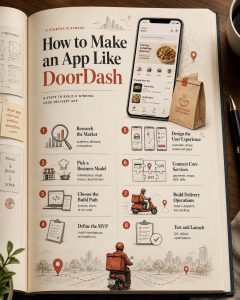
The following 8 steps cover the decisions that will shape your app’s success.
1. Research the Food Delivery Market and Target Audience
Before you make an app like DoorDash, identify where the opportunity actually exists. Look at customer demand, restaurant pain points, delivery economics, local competition, and gaps that established platforms have not addressed well.
For your DoorDash-like app, focus on:
- Customer Demand: Ordering frequency, preferred cuisines, average order value, delivery expectations, and price sensitivity.
- Restaurant Supply: Independent restaurants vs. chains, commission concerns, order volumes, and existing delivery capabilities.
- Delivery Economics: Average delivery distance, peak ordering windows, driver availability, and expected payout per trip.
- Competitor Gaps: Pricing, delivery speed, restaurant selection, loyalty, support, and merchant experience.
- Local Behavior: Payment preferences, traffic conditions, address accuracy, delivery zones, and regulations.
Do not begin by trying to serve an entire country. Start with a focused market where you can build order density and a clear advantage, such as reliable lunch delivery for independent restaurants in busy business districts.
Your research should ultimately answer 3 questions: Who will use the platform? What are competitors missing? And why would customers, restaurants, and delivery partners choose you?
2. Choose the Right Food Delivery Business Model
Once you know where you want to compete, the next decision is how your platform will participate in each transaction. This choice will shape your revenue streams, restaurant relationships, delivery operations, and development requirements
You can consider three practical models:
- Marketplace Model: Customers discover restaurants, place orders, and pay through your platform while you earn through commissions, fees, and other marketplace revenue.
- Logistics-as-a-Service: Restaurants generate orders through their own channels while your platform handles delivery and fulfillment.
- Hybrid Model: Combine marketplace ordering with delivery services for restaurant-owned channels, giving merchants both customer acquisition and fulfillment options.
You can also build around a focused niche such as healthy meals, corporate food delivery, campus delivery, or premium dining.The right model is the one where customer demand, restaurant supply, delivery costs, and revenue per order work together.
Before moving ahead, know exactly how much your platform retains from each transaction and what it costs to fulfill it.
3. Choose Between Custom Development, DoorDash Clone, or No Code
When you make an app like DoorDash, your development approach should match your budget, launch timeline, and how much differentiation you need. There are three practical routes:
- Custom Development: Best when you need a product built around your own workflows, pricing logic, delivery rules, integrations, and long-term roadmap. It gives you greater control over the product, but requires more time and investment.
- DoorDash Clone: A strong option when you want to launch faster with proven food delivery workflows already covered, then customize branding, features, payment methods, and business rules for your market.
- No-Code: Useful for validating a basic concept or customer journey, but complex requirements such as real-time tracking, driver assignment, payment splitting, and advanced delivery workflows can quickly push a serious marketplace beyond no-code capabilities.
For businesses that want either route, Xpertz.io offers both custom food delivery app development and ready-made DoorDash clone solutions, allowing founders to choose between building a differentiated product or launching on a shorter timeline.
4. Define the MVP Scope and Platform Requirements
A common mistake when you make an app like DoorDash is treating the MVP as a smaller version of the entire platform. Your MVP should prove that customers will order, restaurants will fulfill those orders, and delivery partners can complete them profitably.
At minimum, define four product areas:
- Customer App: Registration, restaurant discovery, menus, cart, checkout, payments, order status, tracking, ratings, and support.
- Restaurant App/Portal: Order acceptance, menu management, item availability, preparation updates, order history, and basic sales insights.
- Delivery Partner App: Job requests, acceptance, navigation, pickup confirmation, delivery status, earnings, and support.
- Admin Dashboard: User & restaurant management, delivery monitoring, commissions, refunds, promotions, disputes, and reporting.
Then lock down your first-release requirements like iOS, Android, web, payment methods, maps, location services, and POS integrations.
Keep the first release focused on the complete order cycle, rather than an impressive feature count. Advanced capabilities such as AI recommendations, subscriptions, sophisticated loyalty programs, and restaurant advertising can follow once you have real transaction data.
5. Design the UX/UI for Each User Application
Once the MVP scope is clear, design the experience around speed, clarity, and context. A customer ordering from a phone, a restaurant handling a rush, and a delivery partner navigating traffic should not be forced through the same interaction patterns.
For the customer experience, prioritize fast discovery, easy comparison, clear pricing, and a checkout that requires minimal effort. Keep delivery status and ETAs visible without making users search for them.
For the restaurant experience, reduce unnecessary taps and keep frequently used actions within immediate reach. Order-related information should be easy to scan during busy service periods.
For the delivery experience, make each task obvious from accepting a delivery and reaching the pickup point to confirming the drop-off. Navigation, earnings, and support should remain accessible without distracting from the delivery.
Also map the exception states like late orders, unavailable items, wrong addresses, cancellations, and failed deliveries so users always know what to do next.
6. Integrate Payments, Maps, GPS and Third-Party Services
A DoorDash-like app relies on several external services to keep an order moving from checkout to doorstep. It typically includes:
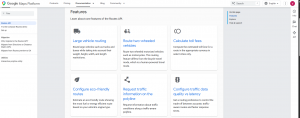
- Maps & Routing: Services such as Google Maps Platform can support address search, geocoding, distance calculations, routing, and ETAs.
- Payments: Support cards, digital wallets, refunds, tips, commissions, and payouts to restaurants and delivery partners. Marketplace solutions such as Stripe Connect can handle payment collection and multi-party payouts.
- GPS & Live Location: Track delivery-partner movement, update order status, calculate ETAs, and show customers delivery progress while managing battery and location accuracy.
- Notifications: Push notifications, SMS, and email can cover order confirmations, preparation updates, driver assignments, delivery alerts, and payment events.
- Restaurant/POS Integrations: Connect restaurant systems to synchronize orders, menus, availability, and pricing without unnecessary manual work.
These integrations should be planned alongside the core product, not added as an afterthought. Payment reliability, location accuracy, delivery visibility, and order synchronization directly influence both user experience and operating costs.
7. Set Up Order Processing, Driver Assignment and Real-Time Tracking
This is where a DoorDash-like app has to handle the operational side of every order. Once an order is placed, the platform needs to coordinate the restaurant, delivery partner, and customer while keeping timing and order status aligned.
Driver assignment is a key part of this process. A basic setup can assign the nearest available delivery partner, but a more effective approach considers travel time, current workload, restaurant preparation time, delivery zones, and existing routes.
Moreover, real-time tracking keeps the delivery visible throughout the journey. Customers need accurate ETAs & status updates, while delivery partners need navigation, pickup details, and simple progress updates.
Your app like DoorDash should also account for restaurant delays, rejected requests, GPS issues, cancellations, unreachable customers, and delivery reassignment, with automated handling wherever possible.
8. Test and Launch Your DoorDash-Like App
You need to validate the entire transaction flow across customers, restaurants, delivery partners, payments, and location services under real operating conditions.
Before launch, test the complete order journey against scenarios such as failed payments, unavailable items, restaurant delays, rejected delivery requests, incorrect addresses, GPS interruptions, cancellations, refunds, and poor network conditions.
Also test each user experience separately:
- Customers: Search, checkout, payments, tracking, cancellations, refunds, and support.
- Restaurants: Order acceptance, preparation updates, menu availability, and order management.
- Delivery Partners: Job offers, navigation, pickup, status updates, and earnings.
- Admin: Dispatch monitoring, disputes, payments, commissions, and user management.
After launch, monitor order completion, cancellation rates, delivery times, repeat orders, customer acquisition costs, and contribution margin. Your first release should prove that orders can be completed reliably and profitably without excessive manual intervention.
Key Features For You DoorDash-Like App
Understanding how to make an app like DoorDash starts with choosing features that improve ordering, delivery, and retention. Following are the key features worth prioritizing:
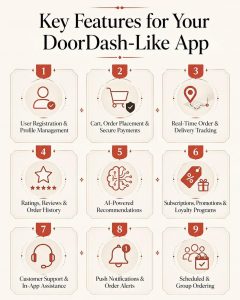
- User Registration & Profile Management – Offer quick sign-up through phone, email, or social login, with saved addresses, payment methods, dietary preferences, favorites, and order history.
- Search, Filters & Menu Browsing – Make discovery useful with filters for cuisine, price, rating, distance, delivery time, dietary preferences, and availability. Menus should clearly display prices, modifiers, add-ons, portions, and item availability.
- Cart, Order Placement & Secure Payments – Show the complete order cost including food, taxes, delivery and service fees, discounts, & tips before payment. Support secure payments, refunds, cancellations, and merchant payouts.
- Real-Time Order & Delivery Tracking – Keep customers informed from restaurant confirmation and preparation through driver assignment, pickup, and arrival. Accurate ETAs matter more than unnecessary map animations.
- Ratings, Reviews & Order History – Allow customers to rate their food and delivery experience, view receipts, revisit previous orders, and quickly reorder their usual meals.
- AI-Powered Recommendations – Use customer behavior, order history, preferences, and context to recommend relevant restaurants, dishes, reorders, and offers. Personalization should improve discovery and conversion.
- Subscriptions, Promotions & Loyalty Programs – Use memberships, free-delivery benefits, loyalty points, referral credits, personalized offers, and restaurant promotions to increase order frequency and retention.
- Customer Support & In-App Assistance – Connect support directly to each order so customers can report missing items, delays, payment issues, or delivery problems. AI can handle routine queries while complex cases move to human support.
- Push Notifications & Order Alerts – Send timely updates for order confirmation, preparation, driver assignment, pickup, arrival, payment, promotions, and delivery completion without overwhelming users with unnecessary notifications.
- Scheduled & Group Ordering – Let customers schedule orders for later, place group orders through a shared link, split payments where supported, and set delivery instructions. This can expand the app into office lunches, events, family orders, and recurring meal occasions.
How Much Does It Cost to Make an App Like DoorDash?
The cost to make an app like DoorDash depends on how much of the delivery business you want the product to handle.
| DoorDash-Like App Type | Estimated Cost |
| Basic MVP | $20k – $40k |
| Mid-Level Platform | $60k – $120k |
| Advanced DoorDash-Like App | $125k – $250k |
| Enterprise-Scale Platform | $250k+ |
These figures cover development estimates, not the cost of running and growing the business. Ongoing costs can range from $1,000 – $5,000+/month, covering hosting, maps, SMS, maintenance, security, support, and other platform services, while payment processing, marketing, and delivery-partner incentives are typically additional.
Don’t Confuse Development Budget With Launch Cost!
A common budgeting mistake is putting the entire budget into development. A food delivery marketplace also needs capital for restaurant acquisition, customer marketing, delivery-partner incentives, support, refunds, maintenance, and market expansion.
DoorDash’s own numbers show how significant these operating expenses can become. In 2025, the company spent $2.48B on sales & marketing, $1.43B on R&D, and $1.60B on general and administrative expenses.
For a new entrant, a practical approach is to reserve at least $50k – $150k beyond development for an initial 6 – 12 months of market launch, depending on the city, acquisition strategy, and delivery model.
Final Thoughts
The smarter way to make an app like DoorDash is to begin with a clear commercial thesis. Choose a market where you can build a strong customer & restaurant base, keep the first release focused, track order-level performance, and expand as demand grows. The goal is to build a business that can sustain demand, not simply launch another delivery app. Xpertz.io can help bring that vision to market through custom food delivery app development or a ready-made DoorDash clone.
FAQs About How to Make an App like DoorDash
1. Can AI improve a DoorDash-like food delivery app?
Yes! AI can personalize restaurant recommendations, predict demand, improve dispatch decisions, identify likely cancellations, optimize promotions, and support customers. Its value comes from measurable improvements in conversion, retention, or delivery efficiency.
2. What metrics to measure after launching a DoorDash-like app?
Track metrics such as order frequency, average order value, cancellation rate, delivery time, repeat purchase rate, customer acquisition cost, restaurant retention, delivery utilization, take rate, and contribution margin to understand whether the model is working.
3. How can a new entrant convince customers to switch from DoorDash?
Give them a reason beyond another discount. Better local selection, lower total fees, exclusive restaurants, reliable delivery, stronger rewards, or a noticeably better experience can create a more sustainable switching incentive.