

TL;DR: Choosing the Right EdTech Development Partner
- Choose custom education software development services when off-the-shelf LMS platforms limit your learning model, workflows, or product vision.
- Evaluate proven EdTech expertise across LMS/SIS integrations, UX, security, accessibility, and scalability, not just the portfolio.
- Ask how the team handles ownership, communication, scope changes, delivery, and post-launch support.
- Budget $25k – $300k+ for custom education software development services, with ongoing costs of around $10k – $35k annually for maintenance, support, hosting, security updates, and third-party services.
- Watch for unrealistic timelines, vague proposals, weak communication, and unclear ownership before signing.
Choosing an education software development company is not simply about finding a team that can build an LMS, learning app, or virtual classroom. The real test is whether they understand how education products work across learners, educators, admins, and business goals.
The EdTech market is projected to reach $437.5B in 2033, according to Grand View Research, reflecting how quickly digital learning products are expanding.
For businesses investing in education software development services, the wrong partner can lead to costly rework, weak adoption, security gaps, and limited flexibility. The right team combines technical expertise with knowledge of learning workflows, integrations, accessibility, data protection, and product scalability.
This guide explains what to evaluate when comparing custom education software development services and choosing a partner built for long-term growth.
When Do You Need a Custom Education Software Development Partner?
Not every education business needs custom software. If a platform such as Moodle or Canvas already handles your courses, assessments, user management, and reporting without costly workarounds, a ready-made LMS may be the smarter choice.
A custom partner becomes valuable when your requirements start moving beyond what standard platforms can handle efficiently:
- Your Learning Model is Different: Competency-based learning, adaptive assessments, cohort-specific paths, instructor reviews, or proprietary teaching methods often require workflows that generic LMS platforms cannot support cleanly.
- Need Complex Integrations: Connecting an education product with a CRM, SIS, payment gateway, video platform, HR system, or identity provider may require tailored educational software development services built around your existing processes
- Software is Your Product: If you are building an LMS, tutoring platform, assessment system, virtual classroom, or EdTech SaaS, your workflows, permissions, dashboards, pricing, and learner experience are core product capabilities.
- Your Current Platform Creates Manual Work: Repeated spreadsheet exports, duplicate data entry, plugin conflicts, disconnected systems, or workarounds are strong signs that your existing software is becoming a bottleneck.
Furthermore, depending on your users and market, requirements may include FERPA, COPPA, GDPR, or accessibility standards. FERPA, for example, protects the privacy of student education records, while COPPA places specific obligations on certain online services collecting information from children under 13.
In these situations, custom education software development services can give you greater control over functionality, integrations, data handling, and future changes, without forcing your business to reshape its processes around someone else’s product.
Key Factors to Consider When Choosing a Edtech Company
This is the part many buyers rush through, and it’s often where the expensive mistakes begin. A strong portfolio matters, but what matters more is whether the company understands the decisions behind education products.
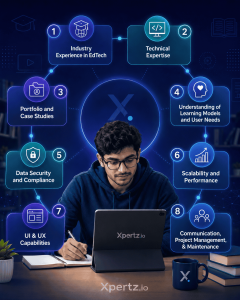
1. Industry Experience in EdTech
A company may be excellent at software development and still struggle with education products. Look for experience with the realities of EdTech like student & instructor roles, course delivery, assessments, certifications, attendance, grading, subscriptions, and institutional workflows.
Ask for projects similar to yours and dig into what the team actually handled. Did they understand the difference between an administrator and instructor workflow? How did they approach learner progress, content access, reporting, or institutional requirements?
The best education software development services partner should be able to challenge your assumptions, identify workflow gaps, and suggest practical improvements based on previous EdTech projects, not simply build whatever appears in the specification.
2. Technical Expertise
Once the domain knowledge checks out, look at whether the team can technically deliver the product. Evaluate its experience with APIs, third-party integrations, web and mobile applications, data security, analytics, performance, and scalability.
For products connecting with LMSs, SIS platforms, assessment tools, or other learning applications, ask about experience with standards such as LTI, OneRoster, and QTI.
Don’t judge technical capability by a list of technologies on a website. Ask for examples of complex integrations, security challenges, performance issues, and how the team handled increasing users, data, and product requirements.
3. Portfolio & Case Studies
A long client list doesn’t tell you much. What matters is whether the company can show relevant education products and clearly explain what it contributed to them.
- Check Relevant Projects: Prioritize LMS platforms, tutoring solutions, assessment systems, student portals, virtual classrooms, or EdTech SaaS products that resemble your requirements.
- Go Beyond Screenshots: A useful case study should explain the business challenge, key workflows, development approach, challenges, and results. Attractive UI alone doesn’t prove development expertise.
- Understand Their Role: Ask whether the company handled product design, development, integrations, migration, testing, and post-launch improvements or only one part of the project.
- Look for Measurable Outcomes: Improvements in user adoption, engagement, performance, completion rates, or operational efficiency provide stronger evidence than generic claims such as “successful project.”
For education software development services, a relevant portfolio with clear project ownership and measurable results is far more valuable than a long list of clients or technologies.
4. Understanding of Learning Models & User Needs
A good development team should understand what happens inside the product, not just what needs to be built. A tutoring platform, corporate training product, and university LMS all work differently.
The team should know how learners enroll, access content, submit work, take assessments, receive feedback, and track their progress. It should also account for the different needs of students, instructors, admins, parents, or corporate managers.
The learning model matters too; Self-paced, instructor-led, cohort-based, blended, and competency-based programs can require very different workflows.
Accessibility also needs attention, with WCAG offering established guidance for accessible web experiences. A capable custom education software development services partner should be willing to question unclear requirements and suggest a better way to handle them.
5. Data Security & Compliance
Education software can handle student profiles, academic records, assessment results, payment information, and data relating to minors. That makes security a business requirement, not something to review at the end of development.
When evaluating education software development services, look at how the company approaches access control, authentication, encryption, backups, data retention, and audit logs across different user roles.
Security also needs to cover how data moves between your platform and third-party services. Ask how the team secures API connections, manages external integrations, monitors suspicious activity, and limits access to sensitive information.
These details become particularly important when the product connects with payment systems, LMS platforms, video services, analytics tools, or student information systems. You should also understand what happens after launch. Ask who handles security testing, vulnerability fixes, software updates, backups, and incident response.
A reliable education software development services partner should have a clear process for identifying and addressing security issues as the product evolves.
6. Scalability & Performance
An education platform may work smoothly with a few hundred users and struggle when an entire institution logs in at once. Live classes, exams, course launches, and result announcements can create traffic spikes that quickly expose performance issues.
When evaluating education software development services, look at how the team plans for:
- Traffic Spikes: Can the platform handle large numbers of students accessing classes, assessments, or results at the same time?
- Content Delivery: Can recorded lectures, course materials, and live sessions be delivered smoothly without affecting other parts of the platform?
- Database Performance: Will search, reporting, learner progress, grades, and dashboards remain responsive as the volume of data increases?
- Growing Usage: Can the product support more students, institutions, courses, regions, and user types without major redevelopment?
- Performance Monitoring: Ask what the team monitors after launch and how quickly performance problems are detected and resolved.
Don’t settle for “it can scale.” Ask for examples of similar products, the usage levels they supported, and how they handled periods of high demand. For custom education software development services, scalability should be based on your expected usage, learning model, and growth plans.
7. UI & UX Capabilities
Education products can become cluttered quickly. Add separate dashboards for students, instructors, parents, and admins, along with courses, assessments, notifications, reports, payments, and live classes, and navigation can become difficult very quickly.
When assessing an education software development services provider, look at how the team handles:
- Role-Specific Experiences: Students, instructors, parents, and admins should see the information and actions relevant to their responsibilities rather than the same interface.
- Simple Learning Flows: Course discovery, enrollment, lesson access, assignments, assessments, and progress tracking should feel straightforward, with unnecessary steps removed.
- Cross-Device Usability: The experience should work consistently across desktops, tablets, and mobile devices, particularly when learners access content on the go.
- Accessibility: Check whether the design follows recognised accessibility practices and considers users with different abilities and assistive technology needs.
- Design Consistency: Navigation, forms, dashboards, buttons, and interactions should follow a consistent design system rather than feeling like separate features built at different times.
For an education software application development service, ask to see prototypes, user flows, or live products. Good UX should make complex learning processes easier to understand and use.
8. Communication, Project Management & Maintenance
Even a technically capable team can make a project difficult when communication is poor. Education products often evolve as stakeholders review workflows, test screens, and uncover new requirements.
Your development partner should have a clear process for handling those changes without losing control of scope, budget, or timelines. When evaluating a partner, check:
- Clear Points of Contact: Know who handles requirements, technical discussions, approvals, and escalations.
- Regular Progress Updates: You should know what has been completed, what is in progress, and where your input is needed.
- Defined Processes: Ask how requirements are documented, prioritised, reviewed, tested, and approved throughout the project.
- Realistic Timelines: A reliable partner should explain dependencies and flag potential delays early.
- Change Management: Understand how new requirements affect development time, priorities, and cost.
- Post-Launch Support: Confirm who handles bugs, updates, performance issues, and future improvements after release. Also clarify response times, support coverage, and whether maintenance is included in the contract or billed separately
For education software development services, good project management is all about keeping responsibilities, decisions, scope, and expectations clear throughout the engagement.
How Much Does Education Software Development Cost?
An LMS, tutoring platform, assessment system, and multi-institution EdTech product can have very different development requirements. Current 2026 estimates put custom education software cost anywhere from $25,000 for a focused MVP to $300,000+ for complex platforms, with enterprise projects potentially going considerably higher.
| EdTech Platform Type | Estd. Development Cost | Typical Scope |
| Basic LMS/ MVP | $25k – $60k | User accounts, course management, basic assessments, progress tracking, admin panel |
| Mid-Level Platform | $65k – $150k | Multiple roles, payments, reporting, video, mobile support, custom workflows, integrations |
| Advanced Edtech Platform | $155k – $300k | Advanced assessments, analytics, live learning, multiple integrations, extensive customization |
| Enterprise Platform | $300k+ | Multi-institution support, advanced reporting, complex integrations, AI features, accessibility, and extensive customization |
After launch, plan for roughly $10,000 – $35,000 per year for a typical education platform, depending on its size and usage. This can cover maintenance, technical support, security updates, monitoring, backups, hosting, and routine fixes.
You may also need separate budgets for video storage and streaming, third-party APIs, payment services, and new feature development. High-traffic platforms or products with heavy video usage can cost more to operate
Questions to Ask Before Hiring an Education Software Development Company
Don’t choose an education software development company based on a polished portfolio or the lowest quote. The better approach is to ask questions that reveal how well the team understands education products, handles technical decisions, and works once the project gets complicated.
- Have you built a product similar to ours? Ask for relevant EdTech case studies and clarify what the company actually developed.
- How would you approach our learning model? The team should understand whether your product is self-paced, cohort-based, instructor-led, competency-based, or a combination.
- What technologies would you recommend, and why? Look for reasoning rather than a generic list of programming languages and frameworks.
- Which integrations will we need? Discuss LMS, SIS, CRM, payment, video, identity, analytics, and other third-party systems early.
- How will you handle learner data and compliance? Ask about access controls, encryption, privacy requirements, audit trails, and applicable regulations.
- How will the platform handle growth? Get specific about expected users, concurrent traffic, video usage, assessments, reporting, and future expansion.
- Who will actually work on the project? Know whether the people presenting the proposal are the same team handling design, development, testing, and delivery.
- How do you manage changes to requirements? Understand how new features affect scope, timelines, and costs.
- What happens after launch? Ask about bug fixes, security updates, monitoring, integrations, maintenance, SLAs, and future development.
- Can you provide client references? Speaking with previous clients can reveal things a sales presentation won’t, particularly around communication, delivery discipline, and post-launch support.
For custom education software development services, these questions help separate a company that can genuinely own the project from one that simply knows how to execute a feature list.
Red Flags to Watch For While Choosing EdTech Development Partner
The wrong Edtech development partner can lead to missed deadlines, unexpected costs, or a product that technically works but doesn’t fit how your education business operates Watch for these warning signs:
- No relevant EdTech experience or comparable education projects.
- Vague proposals with unclear workflows, integrations, timelines, or deliverables.
- Unrealistic delivery timelines that overlook development or testing requirements.
- Suspiciously low quotes that exclude essential services or post-launch support.
- Inability to clearly justify technical decisions or recommended technologies.
- No clear ownership for maintenance, security updates, or future upgrades.
- Slow, unclear, or inconsistent communication during the sales process.
Final Thoughts
Choosing the right education software development company is about finding a partner that understands both technology and education. The right team should help you make better product decisions, manage complexity, and build software that can evolve with your users and business. Xpertz.io is among the leading EdTech development companies, delivering both custom and clone education softwares tailored to specific learning models, workflows, and business goals.
FAQs About Education Software App Development Services
1. What to verify before signing a long-term EdTech development contract?
Clarify ownership, scope, milestones, intellectual property, technology decisions, change requests, support responsibilities, maintenance terms, response times, and what happens if the partnership ends.
2. Can an education software development company improve an existing LMS instead of rebuilding it?
Yes! Depending on the limitations, a team can extend existing functionality, integrate external systems, improve UX, automate workflows, or replace specific components without rebuilding the entire platform.
3. How to evaluate an EdTech company’s QA process?
Ask whether testing covers functional workflows, integrations, security, accessibility, mobile devices, performance, and regression scenarios, rather than relying only on basic feature testing before release.