


In the year 2013, a movie named “Her” launched, where the protagonist was romantically involved with an artificially intelligent being named Samantha. Little did we know that era would become reality this soon.
Today, the application of artificial intelligence across various industries like customer support, medicine, and research is rapidly increasing. With conversational AI becoming more and more efficient, it has given rise to AI-driven interactive platforms like Candy.ai, DreamGF, GPTGirlfriend, and more, changing how humans interact and socialize with AI entities.
With the growing hype and the adoption of virtual companion platforms, in this read, we will let you know how to create a virtual AI companion platform like Candy AI. The guide is comprehensive and follows a step-by-step approach to easily follow up.
What Is a Virtual Companion Platform?
Virtual companion platforms are the latest marvel in the adult industry. Powered by artificial intelligence, virtual companion platforms are designed to keep users hooked by giving them personalized, context-aware experiences by using large language models (LLMs), personality frameworks, memory systems, and real-time communication infrastructure.
What makes virtual companion platforms a highly sought-after option is their ability to stimulate human-like interactions, offer emotional support, and companionship, thereby reducing loneliness for humans. These platforms interact with humans through text, voice, and avatar models. And platforms like Candy AI take it to the next level, where users interact with real-life-like female models, giving them emotional support plus sexual experiences.
This is exactly why the global AI companion market is witnessing an explosive growth, with the market size estimated at USD 28.19 billion to USD 36.8 billion in 2024 and projected to reach over USD 140 billion to USD 554 billion by 2030–2035.
From a usage point-of-view, the USA leads global AI companion app downloads with 16%, followed by the Philippines and Brazil. Nearly 75% of American teens have used AI companions, with 50% using them regularly. And the daily user return rate is higher than 62% for many non-safe-for-work (NSFW) AI apps.
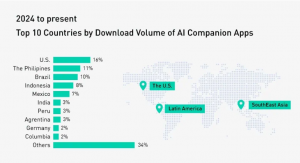
These statistics show the huge potential underlying in this sector and how much people are interested in exploring it, signalling massive usage adoption and revenue growth.
Breaking Down the Candy AI–Style Model
Candy AI was launched in 2023 by Alexis Soulopoulos and quickly gained massive traction for its unfiltered and user-customizable interactive AI companions. The platform gained millions of users and recorded $25 million in annual recurring revenue for 2024.
On a high-level, the platform’s business model is personality-driven, subscription-based conversational engagement. Let’s break it down further to understand better.
1. Perona-Based, Character-Driven Architecture
Candy AI follows a unique business model where users don’t interact with a single generic AI. Instead, the platform provides multiple characters, each having its own personality traits, communication, behaviour, and even visual appearances.
Below are some characters on Candy AI’s homepage, each having its own visual identity and a character trait that comes along, enabling users to immerse themselves in that scenario.
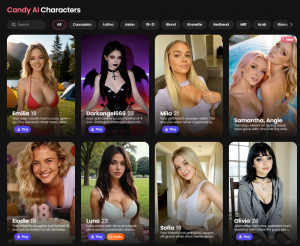
This allows users to choose a personality that meets their preferences, giving them a personalized experience.
2. Continuous Conversational Engagement

When checking a bot named Lana, this was the conversation starter. Prompts like these immediately hook users, encouraging them to spend more time on the platform and significantly increasing overall stickiness.
3. Personalization & Customization Options
It’s not just pre-defined AI companions! Users can also create AI companions according to their preferences. From tweaking how the bot speaks to modifying the visual appearances, users can create their own AI companion on the go.

From a product standpoint, customization increases cash flow from users and a sense of ownership, strengthening retention.
4. Subscription-Based Monetization
Like all other platforms in this category, Candy AI follows a subscription-based monetization structure. The idea here is to give users limited free access, and once they get the hang of it, they are pushed into premium subscription tiers.

Candy AI charges users $12.99 per month as standard. There might also be certain usage-based unlocks and gated features on the platform. Candy AI’s advanced interactions, extended memory, and enhanced customization features make the platform irresistible for its users, making it highly successful.
All of this is powered by various facets of AI (LLMs, context retrieval mechanisms, prompt management systems, etc) orchestrated together, making the front-end look like a simple chat platform.
Candy AI works with retention as the core metric. The platform has all the nuances to attract daily active users, increase the conversation length, and thereby increase and retain the number of subscriptions.
How to Build a Virtual Companion Platform Like Candy AI (Step-by-Step)
Building a platform like Candy AI is more than integrating a chatbot into an interface. It requires a clear roadmap, planning platform design & development, AI embedding, monetization, and more. Here’s how to approach it step-by-step.
Step 1: Define Your Product Strategy
Most founders often have the urge to build something quickly and launch it. But executing things hastily might cause harm in the long-term, making it difficult to scale the business. Which is why founders must clearly define what it is that they want to build, because a strong product strategy acts as the blueprint for success. Founders can start by answering these core questions.
a. Who Is Your Target Audience?
Refrain from building the platform for a large group of people. Instead, research on the age range, how familiar they are with technology, how much they will be able to spend, and what their engagement will be like.
This can help you decide on a few things, like the tone and persona design of your platform, the attention you need to give to the platform’s UI, pricing tiers, and platform restrictions. For a platform like Candy AI, the target audience will mostly be individuals seeking explicit content, lonely/emotionally detached individuals, introverts, ranging mostly between the age 18 and 35.
b. Establish Brand Positioning & Tone
Considering your target audience, how are you going to position your brand, and what will be its tone? Is it going to be playful? Futuristic? Rigid. This will help you stand out and differentiate yourself from your competitors.
For example, Candy AI positions itself as an “AI Girlfriend App.” Muah AI positions itself as “AI Girlfriend/Companion Platform.” And DreamGF positions itself as “AI Girlfriend Chat.” Similarly, find a way to position yourself and make your platform stand out.
c. Set Ethical & Behavioral Boundaries
Since you’re building a website like Candy AI, you can enjoy a certain leeway on the behavioral boundaries. But still, you have to look for the obscenity and nudity laws in the regions where your platform is going to function.
Set boundaries on what type of questions the AI should avoid, how it should handle sensitive topics, and what kind of escalation mechanisms are required.
Establishing rigorous boundaries in the early phase will eliminate any risk in the long-term, improving platform sustainability. By defining your product strategy, you will clearly know what features you need for your platform and the tech behind it, how to phase the product rollout, pricing tiers, and more.
Step 2: Design the AI Personality Engine
This is what sets your virtual companion platform apart from regular conversation AI chatbots. A virtual companion platform is defined by its personalities and interactions. Failing to excel in this section will make your platform inconsistent or generic.
Start by defining the core personality traits for each character. The tone of communication, conversational style, emotional expression, and responsiveness make each character unique and desirable.
Let’s look at how Candy AI has done it.
Harriet is an AI virtual companion, and the projected theme is a new girl in the office. And if you look at the conversation, it resonates, and the chat will revolve around the same topics, too.

Here is another AI virtual companion named Amelia, who is married and on a getaway with husband.

Each virtual companion has its own characteristics and a theme. The clever way to crack this is to build a base personality template that lets you scale multiple characters while maintaining the core ideology intact. Ensure the AI model reinforces character traits as prompts are generated and understands the user’s context before it answers.
Mastering this section will make your virtual companions stand out by being more interactive, relevant, and revolutionary.
Step 3: Deciding on the AI Infrastructure
Your AI infrastructure alone can make or break your virtual companion platform’s success. On a high-level, it’s about integrating with a large language model using an API, but it’s more than that. Making the right decision here is crucial because your platform’s performance and stability, and, most importantly, the operational cost depends on it.
The easiest way would be to integrate with third-party APIs as they are easy to integrate, launch, and manage. But on the other hand, self-hosted open-source models (Dolphin series, Qwen series) offer more control but require complex infrastructure setup and constant optimization.
As a startup, it is better to rely on third-party apps until you scale, but also make sure that the conversations are stored in memory, and before each response is generated, the AI model must respond based on relevant past interactions. Amidst all this, another important factor you must consider is the cost per interaction.
Typically, 1000 tokens cost around $0.03–$0.06, and a user might consume anywhere between hundreds to a few thousand tokens over a single conversation. If your platform has around 5000 daily active users. Your AI process fees could immediately go to thousands of dollars.
This is exactly why you should think both from a technical and financial point-of-view. It’s not just about generating intelligent responses; it’s also about being efficient at the same time.
Step 4: Developing the Frontend for Your Virtual Companion Platform
Once you’re done setting the AI architecture for your platform, the next step is to design the frontend experience for your users. A strong frontend experience is crucial, as it decides whether users will stay engaged on your platform.
Most virtual companion platforms adopt a chat-first layout. And it’s that chat window that has to feel smooth, responsive, and user-friendly because users will be constantly using the window. Make sure not to add unnecessary elements, as they can distract users and reduce platform usage.
Here’s how Candy AI’s messaging window looks.
The chat interface is clean with minimal distractions; only a quick description of the virtual companion and photos. This helps users stay engaged with the chat and free from distractions.
Next, how the character appears is also important. In the earlier section, you might have created a set of AI personalities. You should ensure that the visuals align with the persona you built. Since your platform will be accessed mainly from mobile phones, mobile responsiveness is also critical.
As we proceed, here is a list of must-have features for your virtual companion platform:
- User authentication system
- Chat interface with real-time responses
- Session memory continuity
- Persona creation and customization options
- Dashboard for customizing the profile
- Subscription tiers and payment gateways
These features make your platform market-ready and functional. While advancements can be added later, the above-mentioned features are basic and cannot be skipped at any cost.
Step 5: Backend Architecture & Scalability
Unlike other adult platforms, virtual companion platforms require a robust architecture and extreme reliability. Your backend capabilities should include an AI orchestration layer (as discussed above), memory storage, subscription & billing management, and monitoring & logging systems.
Setting this on one side, your virtual companion platform should need a domain name and hosting services. While choosing a domain name for your platform, remember that it’s going to be your identity in the long-term.
As for choosing a server for your virtual companion platform, make sure your server can,
- Scale traffic spike capacity
- Distribute load across regions
- Manage databases efficiently
- Integrate monitoring tools
Also, keep in mind that your regular servers, like AWS and Azure, might have certain restrictions to impose adult-niche websites. So, choose a hosting server that supports adult website hosting services.
Step 6: Monetization Methods
When planning the monetization model for your virtual companion platform, keep in mind the scalable AI costs, hosting services, and other integration costs, if any. The ideal approach to think about pricing here would be to work on a model that aligns with engagement.
As we already discussed, most businesses in this category rely on a freemium model. Simply put, platform users get access to a limited set of features/number of conversations before they hit a wall and are required to upgrade to access further. The block generally could be conversation limits, restricted customization, capped daily usage, or all of these together.
Subscribing to a premium will give users higher conversation limits, extended memory capacity, advanced customization options, and more premium features. That’s how your pricing models should also be.
We’ve put together the pricing structure from the top AI virtual companions for you below.
Platform Name | Monthly Pricing | Annual Pricing |
1. Candy AI | $12.99 | $3.99 |
2. OurDream AI | $19.99 | $9.99 |
3. DreamGF | $12.99 | $5.99 |
As you see, most platforms offer more or less the same pricing, with some even offering a 3-month package. As a new contender, you can offer lower pricing just to compete with the already established players and to pull in some traffic. But make sure that your characters and AI infrastructure are on point. The downside is that people shouldn’t think the lower pricing is because of the lower standard architecture.
Decide how much you want to give out in the freemium model, because being too generous might spiral quickly. And heavy restrictions might cause a backlash on user conversion. So, make sure to design a revenue model that provides a smooth user experience and is also financially viable.
Step 7: Safety, Moderation & Ethical Design
Since we’re venturing into a territory that has never existed before, safety and moderation cannot be an afterthought. Your platform’s AI should prevent harmful, illegal, or unsafe responses. Beyond this, your AI architecture should be able to filter and detect any harmful prompts. Also, an escalation logic should be in place for repeated violations. Strong measures should be put in place to prevent abuse in any form.
Since all of these are engagement-driven virtual companion platforms, your platform mustn’t have loopholes that intentionally encourage unhealthy usage patterns. Making users understand they are conversing with an AI, and not a human, is also important.
Above all of this, data privacy is critical. All user conversations should be securely stored and encrypted. Privacy policies and data retention rules should be clearly displayed on the website. And an option to delete the account goes a long way in building trust with the users.
Summing it up, a responsible approach is required while building an AI virtual companion platform like Candy AI. This will not only protect your users and strengthen the brand credibility, but also is morally right and reduces operational complexity and legal risks in the long-term.
Step 9: Building an AI Virtual Companion Platform
Having come this far, you clearly know what building a virtual companion platform like Candy AI takes: AI infrastructure, personality systems, backend architecture, monetization methods, and more.
It needs a backend engineering team, DevOps expertise, AI integration, continuous infrastructure monitoring, cost optimization planning, and more. For solopreneurs or startups without expertise, this can be overwhelming, and one small mistake can be expensive and lead to significant delays.
Instead of building all this from scratch (which would take months of development time and costs), the ideal approach here would be to use a pre-built whitelabel platform that has all the features you need to build a virtual companion platform with the front and backend completely taken care of.
xPertz is an adult-niche customized solutions builder enabling thousands of businesses launch websites like OnlyFans, xHamster, LoveHoney, and more. Our team, which has years of experience in the adult industry, has built over hundreds of websites using pre-defined whitelabel softwares and custom development.
You can reach out to one of our experts and learn more about how to build a virtual companion platform like Candy AI. Making the right decision here is crucial as it can directly impact your success rate and long-term goals.
What Challenges Should You Be Prepared For?
Building a virtual companion platform has its own set of challenges, but it’s nothing that we haven’t discussed.
One major challenge is scaling AI costs. As we said earlier, as the user engagement increases, the token usage increases alongside. Make sure to plan your monetization strategy in alignment with your operational expenses. While you do this, ensure user expectations are managed; integrate the right set of LLMs so that users get consistent and engaging responses.
The next challenge is high dependency on third-party platforms. If you depend extensively on third-party platforms, if one fails, then your entire platform collapses. As you scale, make sure you find ways for diversification planning and infrastructure scalability.
Finally, data privacy is crucial, especially in an AI-driven and involved space. Data protection, encryption, transparency, and content governance are all important and go hand-in-hand.
Wading through all these challenges can make your virtual companion platform robust, rigid and sustain it in the long-term.
Is Building a Virtual Companion Platform Worth It?
AI virtual companion platforms weren’t a thing before a year or two. But now, the internet is all over it. The market is in its early phase of adoption, and as we speak, there are more competitors out there building platforms like Candy AI. In the next five or ten years, there will be billions of dollars flowing in revenue through this market.
While the challenges in building a virtual platform like Candy AI are real, with advanced LLMs and tech expertise, it is completely possible. If you’re someone with a clear vision and a long-term mindset waiting to seize the market opportunity, then this is for you. With the right strategy and execution, this venture will be ambitious but successful. So, yes, building a virtual AI companion platform is completely worth it, provided you are early to the race.
