
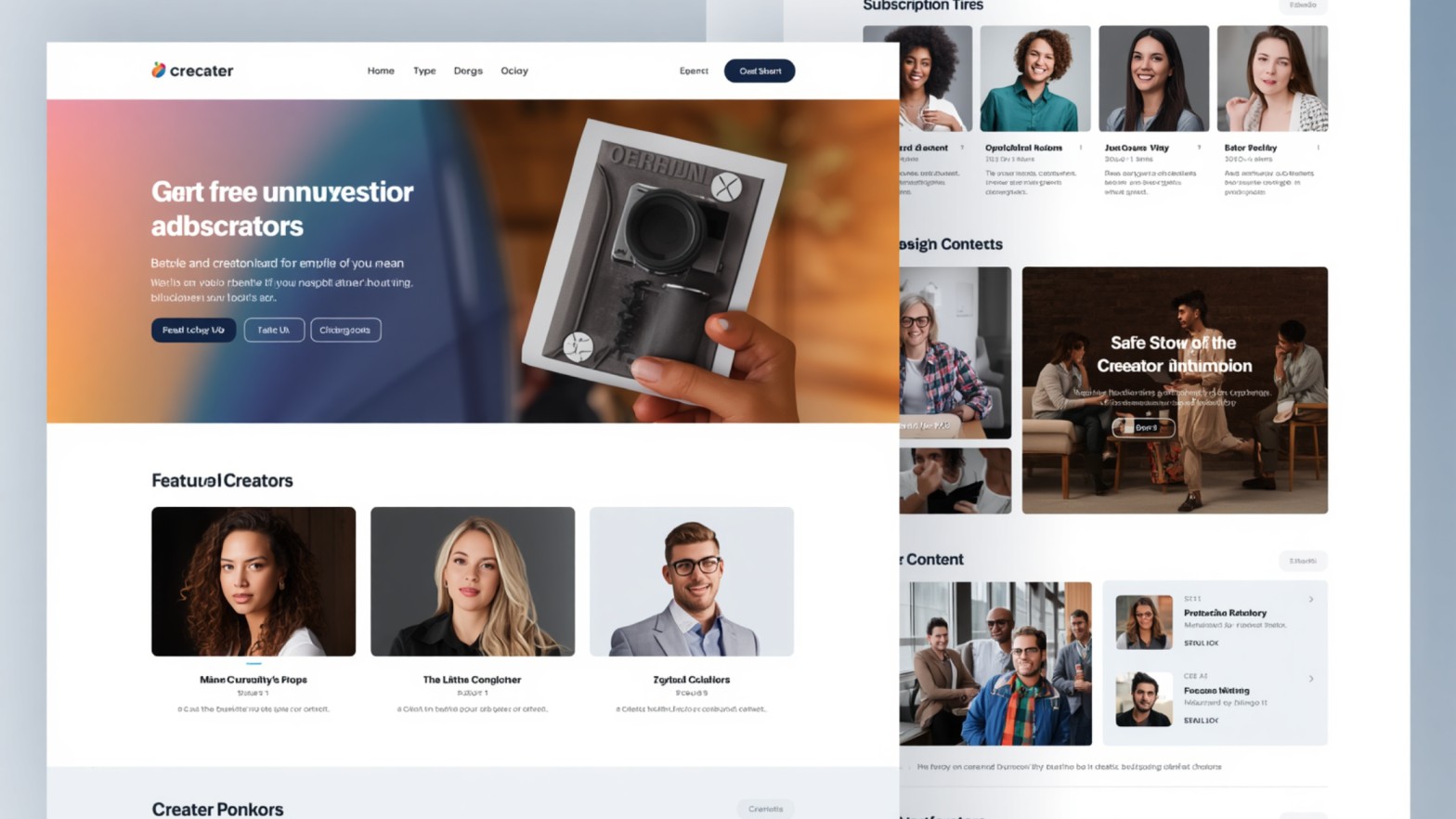

Research confirms that a user’s first impression of a website is formed in under 3 seconds, and 40-50% of visitors will abandon a website with longer loading times. This is perfectly applicable to mobile users, where 53% of them abandon a website if it takes more than 3 seconds to load.
For creator subscription platforms, this can be a nightmare because the frontend is where revenue is won or lost. Because when a user first lands on a creator’s website, they look for trust and credibility. The creator website business model works on ongoing relationships and recurring payments. And users immediately judge based on what they see and how the platform works.
For them to shell out money and become a recurring subscriber, the platform must be intuitive and easy to explore, making engagement effortless and hassle-free. This is a comprehensive guide that explores the important frontend decisions and considerations for building a successful creator subscription platform that promotes conversion, retention, and long-term trust and confidence for subscribers.
What Makes Creator Subscription Site Frontends Different?
Creator subscription sites are not your regular websites, where the sole purpose is to display information. The purpose here is to engage visitors, convert them into paying subscribers, and continue to retain them forever. Platforms like OnlyFans, Patreon, and FeetFinder are perfect examples of creator subscription sites for you to study this model.
The first major difference between a creator subscription site and a normal website is that creator sites bank on repeat visits and recurring payments, not one-time purchases and occasional visits. This means the frontend of the creator sites should constantly engage and deliver value to the audience throughout their lifecycle, not only during the signup phase.
The second difference is the audience the website caters to. Subscription platforms are used by two different audiences: creators and subscribers, with very different use cases.
While creators expect intuitiveness & innovative tools to engage with the audience, subscribers expect smooth discovery, seamless navigation, and content experiences from the platform.
These differences demand that the platform be constructed with good design, clean visual consistency, and predictable instructions. Driven by engagement at the heart, creator subscription sites demand a whole new level of professionalism and precision when compared to traditional websites. Because it’s the subscribers’ money that keeps the platform running and alive.
Core Frontend Goals for Creator Subscription Platforms
When you build a creator subscription platform, it must meet a certain set of goals. And those frontend goals are what keep the revenue flowing constantly. While these goals are met through unique features, let’s look at what the three core goals are.
a. Clarity for Driving Conversion
When a visitor lands on your creator subscription website, they start evaluating your website immediately. And in those crucial first few seconds, they need to know:
- What is this platform about?
- Why is it worth paying for every month?
- Who is this creator?
- How much does it cost?
Users shouldn’t have to endlessly scroll to find the details they need, like what the creators offer or the pricing. The layout should be designed so users aren’t overwhelmed, while the call-to-action should be obvious, prompting them to take action.
The goal is not to overwhelm users with information. But to remove confusion and give clarity as to what they can expect.
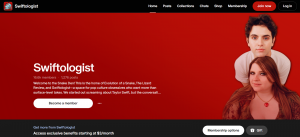
Here is the first fold of the creator named Swiftologist on Patreon. The frontend is designed in such a way that users can understand who the creator is, what offer they value to the subscribers, their metrics, pricing information, and clear CTAs prompting action. This is exactly how the frontend design should be for a creator subscription site: clear, informative, and prompting enough.
b. Proper Engagement Factors to Reinforce Value
The first fold and the sections below act as a factor that pushes the users to subscribe. This is only the beginning of their journey. When users subscribe to several creators, the next thing they’ll expect is engagement.
The user’s feed is what keeps the entire platform alive. And it must feel alive and responsive. Subscribers should be able to find the content of their creators easily without any difficulties with search and categorization options. Media files on the platform should load quickly, and gated vs. ungated content clarity should be well-defined.
c. Establish Trust for Retention and Recurring Payments
Subscription payments carry more psychological resistance than one-time purchases. Users worry about recurring charges, cancellation policies, and billing transparency. Figuring these out and establishing a clear message would reinforce trust and make recurring subscriptions continue. The frontend should be designed in such a way that it proactively reduces these concerns.
The billing cycles should be clear and transparent. The platform should offer clear cancellation or downgrade options. When a user feels that the subscription is in their control and that they can cancel anytime, they don’t feel insecure. This single factor alone reduces frictions, increases conversion, and the retention figures as well.
Must-Have Frontend Features for Creator Subscription Platforms
Now that we understand the goals, let’s break down the features that support them.
a. Creator Landing Page
Here is what the creator landing page of the OnlyFans platform looks like.
The page needs to combine branding, previews, pricing, and calls-to-action in one structured layout. A strong banner, clear bio, visible subscription tiers, and strategically placed subscription buttons are mandatory. A page like this ensures that the necessary information gets communicated to the users.
b. User Registration & Onboarding
The overall process of the signup should be simple. Pages should collect only the most necessary information to make the process seamless. Making the process complicated will increase visitor sign-ups.
c. Content Feed Interface
Subscribers should be able to interact with a feed that collatively contains posts from their subscribed creators, with the options to interact (likes, comments, and tips). Filtering and tagging tools are also important tools for the creator subscription sites.
d. Subscription & Billing Dashboard
Users should have clear access and control when it comes to payment. A detailed dashboard that displays information about active subscriptions, billing history, and the options to upgrade or downgrade and manage their payment methods is crucial.
e. Creator Dashboard
From a creator’s point-of-view, creators need tools to upload content, schedule posts, track revenue, and view analytics. Creator experience is also equally important because if creators find the platform difficult to use, they might not be active, slowing down the platform’s growth.
The features in the frontend matter because every click users make and everything they see can help them make a decision. And with continued seamless experiences, they’ll decide to stick around and continue to pay every month. Because in subscription platforms, customer lifetime is the most important metric, and to keep the markers high, the frontend plays a crucial role.
Frontend Performance & Optimization
The difference between the frontend and the backend is that the backend keeps your platform alive, but the frontend decides whether your platform will survive. Factors like conversion rates, session duration, and retention slowly reduce your revenue.
Here are the key factors to consider when building the frontend for your creator subscription site.
a. Media Optimization for Quick Loading Times
Visitors expect quick loading times of the website (not more than 3 seconds) to stay invested in the website. For this, media optimization is important because creator platforms have high-resolution images, thousands of video previews, thumbnails, and live stream embeds.
To make sure your frontend doesn’t collapse due to the sheet volume of media, you can:
- Compresses images without sacrificing visible quality
- Uses formats like WebP where supported
- Lazy-loads media below the fold
- Appropriately sized thumbnails instead of full-resolution files
- Loads video previews only when necessary
With these optimization techniques, even users with a slow connection can get a seamless experience without buffering.
b. Content Delivery Networks
If your creator platform has a global audience and content collaterals are delivered from a single origin server, latency issues will be more common. To avoid this, integrating CDN in high-volume geographies is crucial.
Assets load from the nearest CDN when requested and eventually reduce the strain on primary networks and speed page rendering across the globe.
CDNs are mandatory if you plan to scale your creator platform internationally.
c. Handling Real-Time Interactions Smoothly
While dealing with real-time infrastructure is a backend responsibility, the frontend is technically responsible for rendering updates instantly. All real-time interactions, including comments, likes, and tipping notifications, should be handled seamlessly without any delays.
Your creator platform’s frontend should not do a full-page reload for uploading content dynamically or do unnecessary re-renders. Your website increases engagement multiple-fold only when the real-time experiences are seamless.
If founders give enough focus on the frontend part as they do for the backend, users would be delighted to use your creator subscription site.
Mobile-First & Responsive Design
Statistics say that approximately 84% to 86% of all traffic on OnlyFans originates from mobile devices, reminding the founder how important mobile responsiveness is. One of the biggest mistakes founders make is treating mobile experiences as secondary.
From discovering creators through social media to subscribing to them and consuming content daily, all of this is done on mobiles, mostly, and not on desktop interfaces. This is exactly why modern creator platforms like OnlyFans, Patreon, and more are designed with a mobile-first approach.
By designing for smaller screens, designers keep only the necessary elements, making the layouts cleaner, accessible, and easy to scan. And not every mobile comes with a screen resolution. This means making the creator platform responsive to multiple device orientations, making the experience seamless when users switch between devices.
Touch-friendly navigation is also a huge part of mobile-responsive design. Users should be able to interact easily with the platform without any accidental or dead clicks. To ensure this, you can make target buttons larger, simplify navigation menus, sticky bottom navigation bars for frequent actions, and even include swipe gestures for browsing content.
When designing for mobiles, designers should remember that the creator’s website should naturally fit into users’ daily routines, making it easy to use during commutes, quick break sessions, and more. Simply put, the design should be efficient enough to make the site a part of their daily digital habit.
Security, Privacy & Trust
Even with all the above in place, failing to figure out security & privacy will not make your site trustworthy, resulting in a higher churn rate, especially if you’re running a sensitive niche platform.
This is highly important because users visit your platform daily, and if it fails to communicate security and privacy clearly, users hesitate to subscribe. While subscribers expect a certain level of anonymity, creators expect their content and meaning to be protected.
a. Secure Authentication & Account Protection
When users and creators sign up for the platform, they should immediately recognize the trust signals. This can be established by:
- Encrypted authentication systems and secure password storage
- Optional two-factor authentication (2FA)
- Login alerts and unusual activity notifications
- Account verification badges to signal authentic creator profiles
Though users don’t interact with these features, for those who know what these are, it immediately instills confidence in the platform.
b. Transparent Payment Security
Since it involves real, hard-earned money, payments are one of the most sensitive parts of a creator platform. Here’s what a creator platform should include with respect to payment security:
- Secure checkout interfaces with SSL encryption
- Integration with recognized payment gateways
- Clear subscription pricing and billing descriptions
- Easy access to billing history and subscription management
Creators should also be assured of their earnings by having them processed accurately and delivered on time.
c. Content Protection & Platform Integrity
Apart from safeguarding creators’ earnings, the platform should also protect creators’ content. The following are some of the methods:
- Watermarking or media protection systems
- Controlled/gated access to premium content
- Protection against account impersonation
- Reporting tools for copyright or abuse violations, and inappropriate content
- Clear community guidelines
Providing a safe ecosystem for both users and creators will instill more confidence and increase usage on the platform. Going beyond all of this, other factors like verified creator badges, clear refund and cancellation guidelines, and responsive customer support channels will make users trust the platform subconsciously, which is the key to increasing usage and retention.
7. Frontend Tech Stack Choices
The choices you make for your frontend tech stack decide how fast, interactive, and scalable your creator subscription site will be. With a heavy reliance on dynamic feeds, real-time interactions, and media playback, your frontend tech stack must be able to handle all of this without sacrificing performance.
a. Core Frontend Frameworks
React.js and Next.js are what most modern platforms use. Next.js builds on React and adds capabilities such as server-side rendering and static page generation, significantly improving loading speeds and search engine discoverability. Since creator platforms are bound to receive heavy organic traffic, this can prove to be an advantage.
b. Styling and UI Frameworks
The most common technology used for this by creator platforms is CSS frameworks such as Tailwind CSS, Bootstrap, and more. Using these frameworks can help developers maintain consistency across the platform while speeding up development timelines. Elements like navigation bars and dashboards can be reused instead of being built from scratch.
c. Media & Video Handling
Efficient media handling is one of the key aspects of a frontend tech stack. Different devices and network speeds play a crucial role as video players, and images should adapt to the changes almost instantly.
Optimized media players and lazy-loading techniques can be used so that heavy files load only when needed. This prevents unnecessary bandwidth consumption and improves overall page performance.
A well-chosen frontend tech stack allows creator platforms to deliver fast loading speeds and smooth media experiences. Choosing the right stack ensures the platform can scale seamlessly as new features and users are added.
Build In-House vs Using Pre-Built Frontend Frameworks & Whitelabel Scripts
Once you have understood the complex process involved in creating the perfect frontend for your creator subscription site, the next step is deciding how you want to develop it. In this case, founders have two options: building it in-house vs. using a whitelabel platform custom-developed for creator businesses.
Building the Frontend In-House
When you build your creator subscription site in-house, you get complete control over the design, functionality, and architecture of your platform, giving you more flexibility, allowing you to tailor every element of the site.
But this also means having the right development team capable of completing the work. This includes long development timelines, increased cost, and unexpected technical complexity, which can increase the overall project’s execution timeline.
Using Pre-Built Frontend Frameworks & Whitelabel Scripts
The other alternative and the better approach to build the frontend of your subscription site is using pre-built frontend frameworks or whitelabel solutions that already include the essential features required for a creator platform. These platforms come with all the above-mentioned features in this blog, making it ready-to-use, more like a plug-and-play approach. This allows founders to customize a whitelabel script and launch their creator subscription site much faster.
This is where companies like Xpertz.io come in. Xpertz is a leading technology partner specializing in building scalable software platforms, web applications, and SaaS solutions for businesses across multiple industries.
With Xpertz, businesses can build fully customized digital platforms tailored to their specific requirements. Their development expertise makes it possible for companies to launch digital products & websites quickly and efficiently.
All solutions are built with a strong frontend and backend architecture, ensuring scalability, performance, and long-term reliability. With a plug-and-play development approach and deep technical expertise, Xpertz makes it easier for businesses to deploy, launch, and scale with confidence.
Which Is the Right Method to Build the Frontend of a Creator Subscription Site?
There’s no right decision or method here. Ultimately, the decision depends on your resources, goals, and timeline.
If you’re planning to build it in-house, you need a dedicated engineering team, $20,000, and three months development timeline. But on the other hand, if you choose to use a white-label script, it means a fraction of the former’s cost, a maximum development timeline of one month, and most importantly, all the development work goes to the experts, and you can launch quickly, allowing you to focus on other important stuff like marketing, growth, and scaling strategies.
The ability to launch quickly and scale seamlessly is a major advantage in the rapidly growing creator economy.
Conclusion
The frontend plays a crucial role in the success of a creator subscription site, letting users decide whether to choose to subscribe or simply abandon.
From setting up highly responsive and engaging creator pages to fast-loading feeds and implementing strong privacy protections, every frontend decision contributes to the success of the platform.
Simply put, in a competitive creator landscape, platforms that prioritize frontend experience will always have the advantage and tend to become more successful.
FAQs on Frontend Development for Creator Subscription Sites
1. How long does it take to build a creator subscription platform frontend?
Building a creator subscription platform frontend from scratch typically takes 1 to 3 months and can vary depending on the complexity of features and the experience of the development team. Alternatively, with pre-built white-label scripts, it can be completed within 3 to 4 weeks.
2. What are the most important frontend features for a creator subscription platform?
The most important frontend features include creator profile pages, subscription management systems, content feeds, secure payment interfaces, and creator dashboards.
3. Why is frontend performance important for creator platforms?
The frontend performance of a creator site is directly proportional to conversion rates, user engagement, and subscriber retention. If the platform’s pages and media load slowly, it leads to abandonment. This is why frontend performance is crucial for creator platforms.
4. Is it better to build a creator subscription platform from scratch or use a whitelabel solution?
While building from scratch gives complete control over the platform’s architecture and design, it requires massive development time, cost, and technical expertise. On the other hand, using whitelabel scripts allows founders to launch faster and focus on growing their platform.
