

TL;DR of Essential Features of a Dating App
- Dating app features should cover the full user journey, from easy onboarding and detailed profiles to discovery, matching, messaging, and ongoing engagement.
- The best features of dating apps depend on the platform type. Mainstream, serious relationship, LGBTQ+, niche, casual, and community-based apps need different discovery, profile, communication, and interaction tools.
- Must-have dating app features such as smart matchmaking, advanced filters, alternative discovery options, real-time messaging, voice and video calls, and personalized notifications help turn profile discovery into meaningful connections.
- Safety should remain a core product priority, with identity verification, fraud detection, block and report controls, AI-assisted moderation, and safe messaging helping protect users while supporting trust and long-term engagement.
The quality of a dating platform is increasingly determined by what happens between a profile discovery and a real conversation. Match Group’s September 2026 Singles in America study found that 47% of US singles said great conversation could spark interest in someone they were not initially attracted to, while shared interests and values followed at 41% & 35%, respectively.
These findings have direct implications for product design. A dating app has to give users enough context to make better choices, surface people they are likely to connect with, and make the next conversation easier.
How well these parts work together can shape everything from the quality of matches to how long users stay engaged. This guide covers the must-have dating app features across onboarding, profiles, discovery, matching, messaging, verification, safety, and engagement.
How Dating App Features Differ by Platform Type?
No single list of features of dating apps works across every product. The right feature mix also depends on who is building the platform and how the product is positioned.
Once the platform type and feature priorities are clear, the next step is finding a team that can execute them effectively. Experience, technical capabilities, and dating product expertise are useful criteria when evaluating top dating app development companies.
| Dating App Type | Example | What Matters Most | Key Features |
| Mainstream dating apps | Tinder, Bumble | Broad discovery, personalization, & multiple ways to connect | Personalized discovery, flexible filters, rich profiles, social modes, messaging, verification, premium visibility. |
| Serious relationship apps | Hinge, eharmony | Compatibility, relationship intent, and profile depth. | Detailed prompts, relationship goals, compatibility signals, curated recommendations, thoughtful likes, conversation tools. |
| LGBTQ+ dating platforms | Grindr, HER | Identity, privacy, intent, & location-based discovery. | Granular identity fields, privacy controls, proximity discovery, advanced filters, messaging, community tools. |
| Niche dating apps | Christian Mingle, JDate | A specific shared interest, identity, lifestyle, or preference | Niche-specific profiles, specialized filters, verification, community rules, relevant discovery tools. |
| Casual dating platforms | Pure, Feeld | Speed, clear intent, & nearby connections. | Proximity discovery, active-status signals, quick chat, intent indicators, media sharing, privacy controls. |
| Community-based dating platforms | Thursday, Meetup-style dating communities | Shared activities, local communities, and interaction beyond 1-to-1 matching. | Groups, events, community feeds, local discovery, group messaging, profiles, direct chat. |
10+ Must-Have Dating App Features
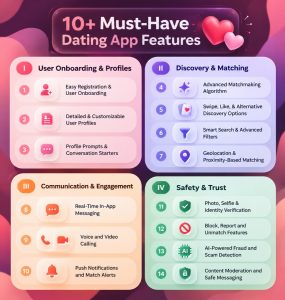
The essential features of a dating app cover four core jobs, i.e, onboarding the right users, helping them find relevant people, encouraging meaningful interaction, and keeping those interactions safe.
These priorities vary by platform, but the following must-have dating app features cover the core capabilities most modern dating apps need to get right.
I. User Onboarding & Profiles
The first set of dating app features should make registration easy while giving users enough control to build a useful, authentic profile.
1. Easy Registration and User Onboarding
Registration should collect enough information to make the first recommendation useful without turning sign-up into a lengthy questionnaire. Email, phone OTP, and supported social sign-in options give users flexibility, while age confirmation should be part of the account creation flow.
Account recovery should also be simple enough to prevent users from losing access because of a changed phone number or email address.
For iOS apps, Apple’s app store review guidelines require an equivalent privacy-focused login option when an app uses certain third-party login services. Age assurance also deserves closer attention in markets introducing stricter online safety requirements, including the UK’s Ofcom age-assurance guidance.
Relationship intent, gender, orientation, and basic preferences can be collected during onboarding. Location and notification permissions are better introduced when the app can clearly explain their value.
The onboarding flow should also let users review or change these choices later instead of locking them in during registration.
2. Detailed and Customizable User Profiles
A dating profile has to do more than establish identity. It should give the matching system useful signals while giving another person enough context to decide whether they want to connect.
Photos, bio, interests, lifestyle preferences, relationship goals, education, languages, and other relevant fields can form the profile. Users should be able to reorder photos, update preferences, and control what information is visible.
Custom fields become particularly valuable for niche platforms. A faith-based service might need denomination and religious practice, while a professional dating platform may need industry or profession. Giving admins control over these fields also makes it easier to adapt the product as the audience evolves.
3. Profile Prompts and Conversation Starters
Prompts solve two problems at once, i.e., they make profiles more expressive and give matches something specific to respond to.
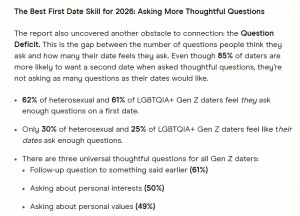
Hinge has made this format a central part of its product, and its own research reinforces the value of conversation. Its 2025 Gen Z report found that 85% of respondents were more likely to want a second date when their date asked thoughtful questions.
Hinge’s Gen Z Dating Highlights the Value of Thoughtful Conversations
For product teams, the value is in what happens after the prompt is answered. Users should be able to respond directly to a prompt, react to an answer, or use it as the starting point for a first message. This gives features of dating apps a more direct role in moving users from profile discovery to conversation.
II. Discovery & Matching
Once the profile is ready, the next set of dating app features should help users discover relevant matches and make better connection decisions.
4. Advanced Matchmaking Algorithm
A useful matching system should combine what users say they want with how they actually behave.
Start with explicit preferences such as age, distance, relationship intent, and orientation. Ranking can then consider shared interests, values, lifestyle preferences, previous likes, replies, skips, and other engagement signals to determine which profiles should appear more prominently.
Reciprocal matching matters too! Ranking someone solely because they receive a high volume of likes can repeatedly expose the same small group of profiles while reducing opportunities for others..
New users present another challenge because the system has little behavioural data to work with. A sensible cold-start strategy can give new profiles enough exposure to generate useful signals before the ranking model becomes more selective.
5. Swipe, Like and Alternative Discovery Options
Swiping remains familiar, but it should not become the only route to discovery. A mature dating product can combine swipe cards with curated recommendations, list or grid browsing, liked-you sections, daily picks, and more deliberate matching formats.
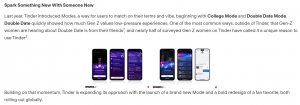
Tinder’s recent product direction illustrates this shift, with AI-powered recommendations, shared-interest discovery, and formats such as Double Date sitting alongside its traditional swipe experience.
The right mix of interactions can also support monetization. Rewinds, Super Likes, profile boosts, and expanded likes can be included in paid tiers while keeping core discovery accessible to free users.
6. Smart Search and Advanced Filters
Search and filters should let users refine discovery based on the attributes that matter most to them.
Common options include age, gender, relationship intent, lifestyle, languages, education, and other profile attributes. Paid plans can introduce more specific controls, such as expanded distance ranges or additional preference filters.
Filters should also work consistently across discovery surfaces, so users do not have to reset their preferences when switching between search, recommendations, or other browsing modes.
7. Geolocation and Proximity-Based Matching
Location is central to dating discovery, particularly for users looking for connections they can realistically meet. Users should be able to set a preferred radius, change their discovery location when travelling, and control whether their distance is visible.
Exact coordinates or overly precise distance information should never be exposed. Location-based features should also account for users who may face additional privacy or safety concerns because of where they live or spend time.
III. Communication & Engagement
After users find a match, the next set of dating app features should make communication easy while giving them control over how and when they interact.
8. Real-Time In-App Messaging
Once two users match, messaging becomes the main test of whether the dating app can turn discovery into an actual connection.
Core capabilities include text, images, GIFs, emojis, delivery and read states, typing indicators, message replies, and reliable sync across devices. Conversation starters and prompt-based replies can reduce the friction of the first message.
Users should have control within the conversation itself. Block, report, unmatch, unsend, and sensitive-image controls should be easy to access without leaving the chat.
9. Voice and Video Calling
Voice and video calls give users another way to interact before exchanging personal contact details or meeting offline.
For the product team, the important considerations are consent, privacy, moderation, and reliability. Calls can be limited to mutual matches, phone numbers can remain hidden, and reporting should remain available during the interaction.
WebRTC can support real-time communication, although many teams choose a managed communications provider rather than building the complete calling stack themselves.
10. Push Notifications and Match Alerts
Notifications should bring users back for meaningful activity without turning engagement into a constant stream of alerts.
New matches, messages, likes, and important account activity are useful notification triggers. Users should have granular controls for notification types, quiet hours, and message previews.
Preview controls are particularly important on shared or public devices, where a lock-screen notification can reveal dating activity to someone nearby.
IV. Safety & Trust
The right dating app features should make safety part of the user journey, from identity verification and scam detection to reporting and blocking unwanted interactions.
11. Photo, Selfie and Identity Verification
Verification has moved beyond a simple blue tick. Tinder’s Face Check uses a video selfie and liveness technology to compare faces and detect duplicate accounts. Tinder reported a 60% reduction in exposure to potential bad actors and a 40% reduction in reports about bad actors in its initial results.
A dating platform can use verification at different levels like photo verification for a basic badge, selfie-based checks for stronger identity confidence, and optional ID verification where the use case requires it. Biometric data needs careful handling, with clear consent, defined retention periods, and compliance with applicable privacy requirements.
12. Block, Report and Unmatch Features
Users should never have to search through account settings to leave an uncomfortable interaction.
Place block, report, and unmatch directly on profiles and inside conversations. Reporting should use clear categories so moderation teams can triage cases consistently, while unmatching should immediately remove the connection according to the platform’s chosen retention policy.
Apple’s app store review guidelines also set expectations around reporting objectionable content and blocking users in apps containing user-generated content.
13. AI-Powered Fraud and Scam Detection
Fraud detection should identify behavioural patterns rather than rely on a single suspicious message.
Useful signals include unusual login locations, repeated messages across accounts, attempts to move conversations to external messaging apps, suspicious payment or investment language, reused images, and abnormal account activity.
The FTC’s guidance on romance scams highlights how scammers often build trust before asking for money or introducing an investment opportunity.
FTC’s Guidance on Romance Scams
AI can help score risk and surface suspicious accounts or conversations for review. High-impact actions such as account suspension or removal should still have appropriate human oversight.
14. Content Moderation and Safe Messaging
Moderation should cover profiles, photos, usernames, messages, and other user-generated content. Automated systems can handle high-volume violations, while trained reviewers can assess ambiguous cases, appeals, and serious reports.
A moderation console should give reviewers the account history, reported content, previous actions, supporting evidence, and available enforcement options in one place. Threats, exploitation, and suspected minors should receive priority over lower-severity reports.
For a dating platform, moderation is part of the product experience. Users form an opinion of the service based on how quickly and consistently it responds when something goes wrong.
Final Thoughts
The right dating app features should support the complete journey, from creating a credible profile to finding compatible people, starting conversations, and staying safe. The strongest products also adapt these features to their audience instead of copying the same feature set across every dating model. For businesses planning a new platform, choosing the right technology, matching logic, engagement tools, and safety controls can shape both launch readiness and long-term growth. Xpertz.io is a leading dating app development company helping businesses build feature-rich dating platforms tailored to their product goals.
FAQs About Features of Dating Apps
1. How does an AI matchmaking algorithm improve a dating app?
AI matchmaking can evaluate profile preferences, behavioural signals, engagement patterns, and compatibility indicators to rank potential matches. The model should continuously learn while maintaining user controls over core preferences.
2. What analytics should dating apps track after launch?
Teams should monitor registration completion, profile completion, match rates, message initiation, response rates, unmatches, reports, retention, subscription conversion, and feature usage. These metrics reveal where users drop off and which features drive meaningful engagement.
3. What are the best engagement features for dating apps?
Conversation prompts, personalized recommendations, match alerts, profile suggestions, reactions, daily picks, and curated discovery can support engagement. The strongest combination depends on whether the platform prioritizes relationships, casual dating, or community interaction.