
TL;DR on Preply App Development Cost
- The cost to develop a language learning app like Preply ranges from $25,000 for an MVP to $300,000+ for an enterprise platform, depending on scope, platforms, and customization.
- Key cost drivers include features, development approach, team expertise, integrations, security, and scalability, with video, booking, payments, and multi-role workflows adding to the budget.
- AI features such as tutor matching, personalized learning, assessments, speech, and translation can add $5,000 – $25,000+, with ongoing costs based on usage.
- Ongoing costs can reach $2,300 – $18,000+ per month for hosting, video, payments, maintenance, APIs, AI usage, & security, making long-term operating costs an important part of the budget.
When Preply co-founder and CEO Kirill Bigai launched the company in 2012, it started with a single landing page focused on helping learners find personalized language tutoring.
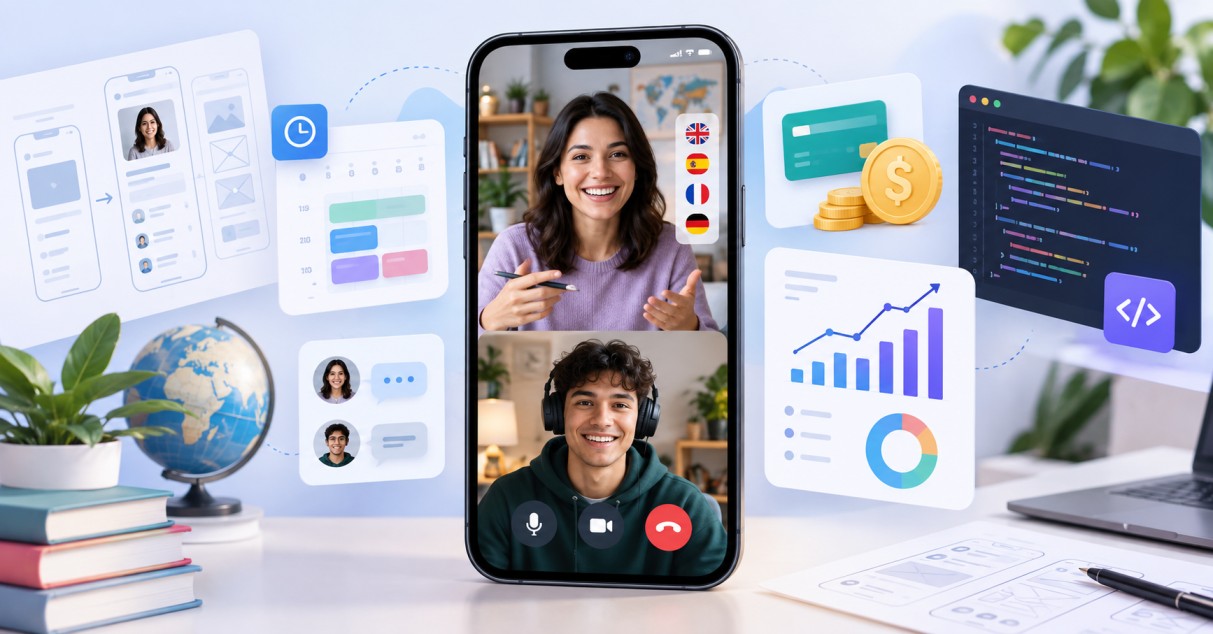
As the business grew, Preply expanded into tutor discovery, scheduling, online classes, payments, and AI-powered learning. Today, it connects 100,000+ tutors with learners across 180 countries and 90+ languages, offering a strong reference for businesses looking to create a Preply-like website.
For entrepreneurs, Preply’s journey shows the value of starting small, validating the product, and expanding as demand grows. A focused launch can cover core tutoring and booking features before adding live classes, subscriptions, and AI tools.
This can keep the cost to develop a language learning app like Preply manageable while creating room to build a larger brand over time.
What Factors Affect Preply App Development Cost?
Two founders can describe the “same Preply app” and end up with quotes $150,000 apart. The gap almost always traces back to the following five variables:

1. Features and Product Complexity
The cost to develop a language learning app like Preply depends heavily on how much of the tutoring journey the product manages digitally. Tutor discovery and booking require a different level of development than a platform supporting tutor matching, trial lessons, recurring bookings, learner progress, reviews, payouts, and personalized learning.
Feature depth also changes the development effort behind individual workflows. A booking system becomes more complex when it must account for tutor availability, rescheduling, cancellations, time zones, reminders, and calendar synchronization. Each additional workflow adds development and testing requirements to the overall budget.
2. Platforms and Development Approach
The number of platforms directly affects the cost to build an app like Preply. A product covering iOS, Android, & web requires more development and testing than a focused launch on fewer platforms.
The development approach also influences the initial investment. A custom-built Preply-like app can be designed around specific business workflows and future requirements, while a clone script can reduce the development effort required for established tutoring functions.
The right choice depends on how much product differentiation the business needs and how quickly it intends to validate the model.
3. Development Team and Location
The team behind the product influences both development rates and the time required to deliver the planned scope. An online tutoring platform may require expertise across product management, UI/UX, mobile and web development, backend engineering, QA, and third-party integrations.
Location affects hourly rates, but it should not be viewed in isolation. Experience with booking systems, tutor marketplaces, payment workflows, live lessons, and multi-role applications can influence the amount of development and rework required, ultimately affecting the total Preply app development cost.
4. Third-Party Integrations
Third-party services contribute to both development and ongoing operating costs. A Preply-like app may depend on external services for payments, live classes, notifications, identity verification, translation, speech processing, and AI-powered functionality.
The initial cost includes integrating these services into the product and handling failures, data flows, and edge cases. After launch, usage-based charges can increase with transactions, lesson hours, active users, and AI consumption.
5. Security, Privacy, and Scalability
Security requirements become more demanding when the platform handles learner payments, tutor payouts, personal profiles, private conversations, and lesson-related data. Authentication, access controls, payment security, data protection, and monitoring all add to development and maintenance requirements.
Scalability is another cost consideration for a growing tutoring marketplace. A platform supporting a larger tutor base, higher lesson volumes, and users across multiple regions requires more robust capacity planning and performance management.
Factoring these requirements into the cost to develop an online tutoring platform like Preply can reduce the need for expensive redevelopment as usage grows.
How Much Does It Cost to Develop an App Like Preply?
The cost to develop a language learning app like Preply varies significantly with the level of product maturity being targeted. An MVP, a full-featured tutoring marketplace, and an enterprise-grade platform involve very different development workloads. The estimates below break down the typical investment and timeline across these stages.
| Preply Clone Development Level | Estd. Cost | Approx. Timeline | Typical Features |
| Preply Clone Script | $1000 – $10,000 | 2 – 8 weeks | Pre-built student & tutor modules, profiles, search, booking, payments, reviews, admin panel. |
| MVP | $25,000 – $50,000 | 3 – 5 months | Student & tutor profiles, search, booking, payments, reviews, basic admin panel. |
| Mid-Level Platform | $52,000 -$100,000 | 5 – 8 months | MVP features plus video classes, messaging, scheduling, subscriptions, notifications, tutor dashboard. |
| Advanced Platform | $120,000 – $180,000+ | 8 – 12 months | AI learning, personalized recommendations, advanced analytics, multilingual support, automated tutor matching |
| Enterprise Platform | $190,000 – $300,000+ | 12- 18 months | Advanced AI, large-scale marketplace capabilities, multiple applications, custom integrations, enhanced security & analytics. |
These figures serve as budgetary benchmarks across different product stages. The final Preply app development cost will depend on the product scope, development model, integrations, and degree of customization required.
Preply-Like App Development Cost Breakdown
The allocation below provides a practical view of where the core development investment typically goes.
1. UI/UX Design
The UI/UX phase defines how learners & tutors move through the platform, from registration, tutor discovery to booking, payments, lessons, and account management. It also covers the design of dashboards, tutor profiles, search, scheduling, and the virtual classroom experience.
The cost depends on the number of screens, platforms, user roles, interaction complexity, and whether the product requires custom classroom or learning interfaces.
Estimated development cost: $3,000 – $8,000
2. Student and Tutor App Development
This stage turns the approved designs into functional learner and tutor applications. The learner side typically includes registration, language preferences, tutor search, profiles, reviews, messaging, bookings, lesson history, and payments. The tutor side covers profile management, pricing, availability, calendars, student management, and lesson tools.
The development effort increases when the product supports multiple platforms, real-time messaging, push notifications, advanced search, complex booking workflows, or automated tutor matching.
Estimated development cost: $15,000 – $40,000
3. Backend and Admin Panel
The backend handles the business logic and data exchange behind the applications. It manages user accounts, tutor profiles, bookings, lesson records, payments, notifications, reviews, and other platform activity.
The admin panel gives the business team control over tutor verification, users, transactions, complaints, content, reports, and platform settings.
The cost rises with the number of workflows the backend needs to manage, administrative roles, reporting requirements, automation, API connections, and custom business rules.
Estimated development cost: $8,000 – $20,000
4. Video, Scheduling, and Booking
This part manages the operational side of tutoring sessions. It includes tutor availability, time-zone handling, calendar management, trial lessons, recurring bookings, rescheduling, cancellations, reminders, and virtual classroom functionality.
Using a third-party video service can reduce the development work required for live classes, although usage charges become part of the ongoing operating cost.
Estimated development cost: $6,000 – $15,000
5. Payments and Subscriptions
The payment layer handles financial transactions between learners, tutors, and the platform. Development may include checkout, recurring billing, tutor payouts, refunds, transaction records, payment status tracking, and support for multiple currencies.
The complexity increases when the business uses recurring lesson packages, tutor-specific pricing, automated payouts, refunds, or marketplace payment rules. Services such as stripe billing and stripe connect can provide the underlying payment and payout capabilities.
Estimated development cost: $3,000 – $8,000
6. Testing and Quality Assurance
Testing validates whether the completed platform performs reliably across its key user journeys. This includes checking registration, tutor discovery, booking, payments, lesson access, messaging, notifications, and account management across supported devices and browsers.
The cost is influenced by the number of platforms, device combinations, third-party integrations, payment scenarios, and testing cycles required before launch.
Estimated development cost: $4,000 – $10,000
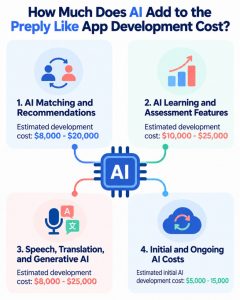
How Much Does AI Add to the Cost?
AI can further increase the cost to develop a language learning app like Preply through personalized learning, tutor matching, model integration, and recurring usage.
1. AI Matching and Recommendations
An AI-powered matching system can evaluate learner preferences, language level, learning goals, availability, budget, tutor ratings, and previous activity to recommend suitable tutors.
More advanced systems can refine these recommendations using booking patterns, lesson history, and learner engagement.
Estimated development cost: $8,000 – $20,000
The cost varies based on whether the matching logic uses predefined rules, third-party AI models, or a custom recommendation system that learns from platform data
2. AI Learning and Assessment Features
AI can extend the learning experience through personalized exercises, vocabulary practice, lesson summaries, automated feedback, progress analysis, and proficiency assessments.
These features require defined learning workflows, prompt logic, evaluation criteria, and safeguards to maintain the quality of AI-generated feedback.
Estimated development cost: $10,000 – $25,000
Ongoing costs depend on the frequency of AI interactions, model selection, context length, and the amount of personalized content generated for each learner.
3. Speech, Translation, and Generative AI
Voice-based learning introduces additional AI services for speech recognition, text-to-speech, pronunciation analysis, translation, and conversational practice. These services are generally usage-based, so costs increase with the volume and duration of learner interactions.
Estimated development cost: $8,000 – $25,000
Real-time voice conversations, pronunciation scoring, multilingual support, AI-generated exercises, and other advanced capabilities can increase both integration effort and recurring usage charges.
4. Initial and Ongoing AI Costs
The initial AI investment covers model integration, prompt and workflow development, testing, evaluation, and connecting AI services with the core application. After launch, recurring expenses can come from text generation, speech processing, translation, embeddings, and other model requests.
Estimated initial AI development cost: $5,000 – 15,000
The ongoing bill is driven primarily by active users and usage intensity. Frequent AI conversations can generate considerably more model consumption than occasional use.
Selecting appropriate models for different tasks, limiting unnecessary context, and using caching where supported can help keep recurring AI costs under control.
Ongoing Cost of Running a Preply-Like App
The cost to develop a language learning app like Preply is only the initial investment. Once the platform is live, recurring expenses become part of the operating budget and can increase as the user base and lesson volume grow. The ranges below provide practical budgetary estimates for ongoing platform costs.
| Ongoing Cost | Estd. Monthly Cost | What It Covers |
| Hosting & Video Services | $500 – $5,000+ | Cloud hosting, databases, storage, content delivery, & live video for tutoring sessions. |
| Payment and API Fees | $300 – $3,000+ | Payment processing, tutor payouts, currency conversion, notifications, translation, & other third-party APIs. |
| Maintenance and Support | $1000 – $5,000+ | Bug fixes, security updates, performance improvements, platform updates, monitoring, and technical support. |
| AI Usage and Security | $500 – $5,000+ | AI model usage, speech processing, translation, embeddings, security monitoring, backups, and vulnerability management. |
How to Reduce Preply App Development Cost?
Reducing the cost to develop a language learning app like Preply does not require cutting core functionality. Focused decisions around scope, technology, and development approach can help control the initial budget:
- Start with an MVP by launching essential features such as learner and tutor profiles, tutor search, booking, payments, messaging, and basic lesson management.
- Use third-party services for video lessons, payments, notifications, and other standard functions instead of developing these systems internally.
- Consider a Preply clone script to launch standard tutoring features with less initial development work, then customize the product around specific business requirements.
- Prioritize features that directly support tutor discovery, bookings, payments, and learner retention before investing in lower-priority functionality.
- Choose cross-platform development when suitable to share code across iOS or Android and reduce development & maintenance effort.
- Use AI selectively for functions such as tutor matching, personalized learning, and assessments where it provides measurable product value.
- Scale gradually by matching hosting, services, and technical capacity to actual user and lesson volumes rather than paying for higher capacity too early.
Conclusion
The cost to develop a language learning app like Preply depends on the product scope, technology choices, AI capabilities, integrations, and ongoing operating requirements. Starting with a focused MVP can help validate demand before investing in advanced tutoring and learning features. For businesses planning to build or scale an online tutoring platform, Xpertz is a leading e-learning app development company offering both ready-made and custom solutions for Preply-like platforms.
FAQs About Preply App Development Cost
1. How much does it cost to add multilingual support to a Preply-like app?
Costs depend on the number of supported languages, translated interfaces, localization workflows, content volume, and whether AI-powered translation is required for lessons, messaging, or learning materials.
2. What affects the long-term operating cost of a Preply-like app?
Active learners, lesson volume, video usage, transactions, AI interactions, storage, support requirements, and geographic reach all influence monthly operating expenses as the platform grows.
3. Can I build a Preply-like app for under $50,000?
Yes, a focused MVP can fit within $25,000 – $50,000 by limiting the initial feature set, using third-party services, choosing suitable development approaches, and postponing advanced AI and analytics.