

The creator economy is on track to cross $500 billion by 2030. And there are over 200-300 million creators actively making money. The rise in new creator platforms has reached a new high due to the increased availability of modern, scalable tech.
But, at a high level, from a user’s point of view, how does a creator platform work? How is it that the creator platforms can handle massive traffic, live streaming, and payment requests all at once without breaking or even causing a glitch? As a founder or an enthusiast, this question and the answer to it can make a huge difference in your venture.
In this guide, we will break down the core infrastructure founders need to know about the backend architecture of high-traffic content creator platforms without getting into unnecessary technical complexity. If you’re planning to build a subscription platform like OnlyFans or a live-streaming platform like LiveJasmin, this backend architecture blog is all you need.
1. What Makes Creator Platforms Technically Demanding?
Diving deeper, from the outside, a creator platform might look like your everyday subscription platform, or a SaaS product. Creators will sign up to upload content, go live to engage with their fans, and make money. On the other hand, users will sign up to consume whatever content is available on the platform. But, behind the scenes, the creator platforms operate under a high-level of pressure.
Stating the first obvious challenge, when a creator or a user logs in to the platform, hundreds or thousands (or even millions) of other creators and users might be active at the same time. This usage might even scale during times of specific events and premieres, breaking the infrastructure.
The second challenge is interacting in real-time. Creator platforms generally come with features like live streaming, comments, tips, and more, requiring the platform to respond instantly. Even the slightest delay can cause dissatisfaction among the platform users.
The next challenge is heavy media. When creators upload videos, broadcast live, or store images, it consumes significant bandwidth and storage, adding another layer of complexity to the existing ones.
Then comes the most important challenge, which is payment and subscription management, followed by the scaling complexity. The creator platform should seamlessly handle recurring billing, revenue sharing, and more. As for scaling complexity, one viral clip or a celebrity moment can multiply traffic on an unimaginable level. The backend system should be able to handle unpredictable patterns of growth.
Before understanding how the backend of the creator platform works, you need to understand that these platforms have millions of people in and out of them every second.
2. The Core Backend Building Blocks
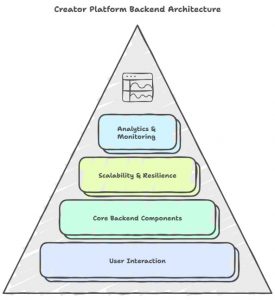
A creator platform works seamlessly due to several core building blocks working together. While you don’t need to be an expert in each one of them, you need to understand what each block is and how it contributes to the functioning of the creator platform.
- User Authentication & Account Management: This system handles registrations, logins, password recovery, and role-based access. If any issue occurs during authentication, fails or becomes slow, the entire platform experience breaks down.
- Content Storage & Delivery Infrastructure: Creators generate massive amounts of videos & images, and conduct live stream shows. The backend platform should be capable enough to store all of this content securely and deliver it across CDNs. On failing to do so, it will result in extensive buffering, delivery lag, and poor video streaming quality.
- Payment & Subscription Management: The payment system, which is responsible for subscriptions, revenue sharing, and more, must work seamlessly, be reliable, and secure because financial errors are among the fastest ways to lose credibility.
- Real-time Communication Layer: Instead of a simple request-response system, these are handled using persistent connections to handle features like live chat, comments, tipping, notifications, and more.
- Moderation & Reporting: The platform should be capable enough to detect abuse, flag it, and enable admins to maintain the platform’s integrity. Abuse is a common issue that creator platforms face, especially with scaling traffic.
- Analytics & Monitoring: Beyond all the above, you need to know how the platform is performing by taking into account metrics like server load, response times, user engagement, and payment transactions.
All the above-mentioned are the key building blocks of a creator platform. Each block takes care of a specific business function, and all of them must work seamlessly for the platform to work as expected.
3. Real-Time Infrastructure: Handling Live Traffic
Amidst all the creator platform blocks, the first susceptible block is real-time systems, as it is constantly under stress.
Traditional websites work in a way where users send requests to the server, and the server responds once. But, in the case of a creator platform, real-time infrastructure has to maintain persistent connections. While technologies like WebSockets are used for this purpose, the biggest challenge is when a huge traffic spike occurs, where each user on the platform will be interacting in some way or another.
To ensure that the servers are not overwhelmed, a scalable creator platform should rely on:
- Load balancers to distribute the incoming traffic to multiple available servers
- Infrastructure that can scale capacity during times of high demand
- To prevent overload during volume surges, queue systems should be present
Live traffic surge cannot be predicted. It can happen multiple times in a week, or never happen at all, at least during the initial phases of a creator platform. But the takeaway here is, your platform should be able to handle high volumes of traffic and interaction without collapsing, acting as the key to your platform’s reputation and revenue.
4. Media Infrastructure: The Silent Cost Center
The most underrated and expensive part of a creator platform during the scaling phase. As your creator platform grows, every moment, there’s going to be more video uploads, live streams, and video plays, each action consuming storage and bandwidth.
- Here’s what usually happens when a creator uploads a video onto the platform:
- The original file has to be stored.
- Transcode it into multiple resolutions (e.g., 1080p, 720p, 480p)
- Thumbnail previews are generated
- Distribute the video globally through a content delivery network (CDN)
Each of these processes incurs processing time and cost, and it can multiply, especially during the viral moments. If one of the video on your platform is being streamed simultaneously, the data transfer costs can scale rapidly. With proper CDN integration in place, your primary server will not have to handle all the load by itself.
Another overlooked expense in long-term storage. The higher the number of platform creators you have, the higher the storage and billing costs associated with it. This is exactly why foresight is needed, and a strategy for lifecycle management should be in place.
Building a robust media infrastructure is crucial for preventing downtimes or frequent maintenance breaks.
5. Database & Performance Optimization
One common mistake founders make while building a creator platform is that they do not anticipate the platform growth, which can happen anytime. The databases of creator platforms constantly handle user data, content metadata, payments, comments, subscriptions, and more, all at the same time. And founders often end up assuming that a single database setup will scale infinitely.
But things work otherwise. As the number of operations increases, the lag in the response time increases as the system is under constant load. This reflects in the front end, affecting the user experience, disguised in page load times, live interactions, and payments.
What can be done here is that caching layers can be introduced to store the frequently accessed data. This will avoid querying the database every single time, reducing the latency and server load.
Databases need to maintain constant responsiveness despite constant load. Even the smallest delays can add friction, especially during live experiences.
6. Scalability & Cloud Strategy
Realistically, a creator platform wouldn’t be getting millions of users on day one. It’s about making sure that your platform can handle the scalability without the need for a complete breakdown. For creator platforms, growth does not occur in a linear phase. It occurs in frequent traffic bursts as a result of viral content.
This is why modern creator platforms depend on cloud infrastructure, as it allows resources to scale as per the need. The ability of cloud environments to automatically increase and decrease capacity ensures your platform is up and responsive during traffic surges while eliminating the costs during low-traffic periods.
This is called horizontal scaling. Instead of making one single server powerful, more servers are added to equally distribute the load. In case an unexpected session brings in more traffic, the architecture should provide additional resources. Another key aspect to keep in mind is the regional distribution. Keeping servers spread across different geographies reduces latency and improves streaming performance for users.
Ensuring scalability is a built-in capability rather than a future fix is the important key takeaway from this section.
7. Building Everything In-House vs Use a Structured Backend Platform
Reading this far might have made you understand the technical complexities and intricacies of building a backend platform that can handle high-traffic. So after this, what would be your decision? Building it in-house, or using a structured backend platform? Let’s look at what each of them is.
Building Everything In-House
Building a backend architecture from scratch gives you complete control over the architecture and workflows, even allowing you to customize as and when you want. But building a high-traffic handling architecture is possible only with expert engineering teams. Even then, it will have to go through long development and testing cycles.
But there are trade-offs, too. Infrastructure provisioning, real-time interactions, media storage, and scaling logic are some things you need to take care of. As the platform scales, teams have to work full-time to keep the platform running, and this also involves higher engineering costs.
Using a Structured Backend Platform
On the other hand, structured backend platforms work differently. These are pre-built platforms for high-traffic creator platforms. These platforms come with pre-built components for authentication, real-time communication, media handling, scaling, and monitoring. This means that founders don’t have to spend time managing the infrastructure. Instead, they can focus on the platforms, creators, and growth strategies.
Xpertz is a white-label turnkey solutions provider enabling businesses to build websites like Candy AI, OnlyFans, LiveJasmin, PornHub, and more. All their scripts are built to handle high-traffic, thanks to the scalable backend foundations. Teams do not have to assemble every component themselves. The approach is more like plug and play.
Choosing this approach can reduce the overall development timeline and the risks involved in infrastructure development. Early infrastructure mistakes can also be eliminated, as it might cost teams a huge price down the line.
Choosing the Right Path
There’s no correct choice here. It all depends on resource availability, goal timelines, budget, and more. An experienced team of engineers may need to be paid well to complete the task, and the long development cycles. It also requires constant maintenance and expertise, which incurs cost.
But on the other hand, while label scripts come with everything you need and maintenance is also taken care of by their team, allowing you to move forward with a quick launch! So, it all comes down to you.
9. Common Backend Mistakes Founders Make
Many backend issues don’t come from poor technological choices. It comes from overlooking what’s obvious!
One common mistake is building for the present, not the future. Founders fail to acknowledge the fact that their platform might scale, and always tend to start small. But when the traffic slowly starts to build up, it might be too late for them to take scalability measures. On the other end, some teams build too much, too early, adding unwanted complexity even before the platform starts to gain traction, increasing the maintenance burden.
Another common mistake is underestimating media and bandwidth costs. While the initial stages are covered, the later stages are overlooked and outgrow the revenue.
And finally, dependency risks are often overlooked. Founders should not heavily depend on a single cloud provider or payment processor to run the creator platform. A backup is always necessary in case of any tech disruptions.
Conclusion
Building a backend architecture, especially for a high-traffic handling creator platform, is not a one-day job. It requires months of dedication, precise technological decisions, and an expert engineering team.
Many creator platforms fail to succeed because their core foundation cannot support scalability. Faulty decisions lead to platform outages, rising costs, and poor user experience, leading to abandonment and bad word-of-mouth.
So, the takeaway from this article is pretty simple. Whether you are building a backend architecture in-house or using a structured backend platform provider like Xpertz, make sure to create a stable and scalable foundation.
While users may not see it visibly, the impact is felt every time they enter and interact with the platform and creators in it. Realizing that reliability is a competitive advantage in the creator economy is the first step to success.
