

TL;DR – Legal Requirements for Running a Webcam Business in the USA
- Running a webcam business in the USA is legal, but operators must comply with strict federal, state, and local regulations to avoid fines, penalties, or shutdowns.
- 18 U.S.C. § 2257 compliance is mandatory, requiring age and identity verification records for all performers and making those records available for federal inspection.
- Webcam platforms must follow obscenity laws, as content deemed obscene under the Miller Test is not protected by the First Amendment and can trigger criminal prosecution.
- COPPA compliance is critical, meaning webcam businesses must prevent minors from accessing the platform and must never collect personal data from children under 13.
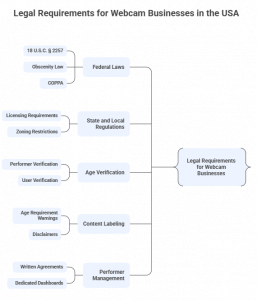
- State and local licensing, zoning laws, age verification systems, content labeling, creator agreements, and data protection regulations are all essential for lawful and uninterrupted operations.
Operating a webcam business is legal in most U.S. states, provided it complies with applicable federal, state, and local laws. However, legality alone does not eliminate the need for compliance. Webcam businesses must comply with several key legal requirements and regulatory considerations to operate smoothly and avoid legal issues.
From complying with 18 U.S.C. § 2257 record-keeping requirements to implementing reliable age-verification systems that verify all users and performers are of legal age, there are multiple compliance areas to address. Failure to meet these obligations can expose the business to serious legal consequences, including fines, penalties, or shutdowns.
In this blog, we’ll cover key legal requirements that webcam businesses in the United States must comply with to operate lawfully.
What are the Federal Laws Governing Webcam Businesses?
There are a few key laws that govern the adult webcam business, which we will look at here.
1. 18 U.S.C. § 2257: Record-keeping requirements
18 U.S.C. § 2257 is one of the most important federal laws governing the adult industry in the United States, and it applies to webcam businesses as well. The primary purpose of this law is to ensure that all performers featured in sexually explicit content are at least 18 years old at the time the content is created.
Under this law, web-based adult content producers and platform operators must:
- Maintain age and identity verification records for every performer appearing in sexually explicit content
- Collect and store government-issued ID documentation, including the performer’s legal name, any aliases, and date of birth.
- Ensure records are appropriately organized and readily available for inspection by authorized federal authorities upon request.
Failure to comply with Section 2257 can result in serious legal consequences, including fines and potential imprisonment. For a first offense, penalties may include up to several years in prison, with harsher penalties possible for repeat or willful violations.
If a webcam business fails to maintain proper 2257 records, it may be legally presumed to be hosting or distributing content involving underage performers, one of the most serious criminal offences in the adult industry.
2. Obscenity Law
In the United States, adult content is legal unless it is classified as “obscene.” Obscene material is not protected under the First Amendment and can be restricted or banned entirely, even if all performers involved are consenting adults.
U.S. courts use the Miller Test (established in Miller v. California, 1973) to determine whether content is obscene.
Webcam platforms stream content nationwide and globally, but obscenity is judged using local community standards. This creates legal risk, as content that is acceptable in one state or jurisdiction may be considered obscene in another.
As a result, webcam businesses must adopt content moderation policies that are more conservative than the strict legal minimum to reduce exposure to enforcement actions.
In the USA, a porn distributor was federally prosecuted for distributing obscene content. The company argued that its material was protected under the First Amendment. However, the case demonstrated that adult businesses can still face criminal charges if their content is deemed obscene, even when it involves consenting adults.
3. Children’s Online Privacy Protection Act (COPPA)
The Children’s Online Privacy Protection Act (COPPA) is a U.S. federal law designed to protect the privacy and personal data of children under 13. While webcam businesses are not intended for children, COPPA is still highly relevant because it governs what happens if a platform knowingly or inadvertently collects data from minors.
How COPPA Applies to Webcam Businesses
- Adult webcam platforms must not collect, use, or store personal information from children under 13 under any circumstances.
- Personal data includes names, email addresses, IP addresses, device identifiers, location data, photos, and video recordings.
- Webcam sites are expected to clearly state that their services are for adults only and to take reasonable steps to prevent children from accessing or interacting with the platform.
Even though webcam businesses are adult-only by nature, failure to implement clear age restrictions and privacy safeguards can still trigger COPPA liability, especially if minors gain access or provide personal information.
4. State and Local Licensing Requirements
While federal laws apply uniformly across the United States, state and local regulations governing webcam businesses can vary significantly. Webcam operators must comply not only with federal statutes but also with state laws, county ordinances, and city-level regulations, especially if they operate from or maintain a physical location.
Examples of State and Local Regulations
- Arizona (Tempe): Certain cities require annual adult business licenses for studios or agencies operating within city limits.
- Connecticut (Hartford): Adult entertainment businesses are restricted from operating within 1,000 feet of schools, churches, or residential zones, particularly when a physical studio is involved.
- Many states and cities impose zoning restrictions, operating permits, and renewal requirements for adult-oriented businesses.
These rules are primarily designed to regulate physical adult entertainment facilities, such as studios or production spaces open to performers or staff.
5.Age Verification for Creators and Users
Age verification is one of the most critical compliance requirements for any webcam business, but the legal obligations differ for creators (performers) and users (viewers). Implement reputable age-verification software as part of the process to ensure you meet all legal obligations regarding the age of platform users.
Webcam businesses must:
- Verify that every performer is 18 years or older
- Collect and store government-issued ID
- Record legal name, aliases, date of birth, and ID details
- Maintain records in an accessible format for federal inspection
6. Labeling requirements for “sexually explicit content.”
This refers to labelling content properly before granting users access, so they know what they are getting into. Any adult content must be clearly labeled on the website (e.g., age requirement warnings, disclaimers) so users understand what they will access. Operators also generally put an 18+ confirmation before entry as part of best practice (and to demonstrate efforts to restrict minors).
7. Performer / Creator Agreement and Management
Managing creators properly is essential for running a webcam business legally and smoothly. All creators should sign written agreements clearly defining revenue share, payout schedules, content rights, platform rules, and termination terms. This helps prevent payment disputes, copyright claims, and legal conflicts.
Transparency is equally important. Providing creators with a dedicated dashboard where they can track earnings, payouts, and performance builds trust and reduces the risk of legal action.
Most professional webcam platforms use separate dashboards for creators, users, and admins to improve clarity and compliance. Many webcam website building software, such as xCams by Adent.io, include these features to ensure transparent creator management and smoother operations.
Other Legal Requirements
In addition to adult-specific laws, webcam businesses must comply with general business and data protection regulations. This includes business registration, tax filing, proper content ownership agreements, workplace safety standards, and secure handling of payments and user data.
Along with it, CCPA or GDPR compliance is mandatory, requiring lawful data collection, user consent, and secure storage of personal information. Failure to comply with these obligations can result in substantial fines, lawsuits, account closures, or criminal liability, even if the adult content is legal.
Important:
- Webcam businesses that operate entirely online, especially from private residences, are not automatically subject to “adult entertainment facility” licensing requirements in many jurisdictions because they do not serve the public at a physical location.
- However, this does not exempt online operators from all state or local laws; general business registration, tax compliance, and zoning rules may still apply.
- If you plan to open a physical webcam studio, shared production space, or agency office, local licensing and zoning compliance becomes critical and should be reviewed carefully before launch.
Conclusion
Running a webcam business may seem daunting if you are unfamiliar with the legal requirements involved. However, once these regulations are understood and properly implemented, operating the business becomes far more manageable. This article highlights key legal obligations governing webcam businesses in the USA, including age verification, 18 U.S.C. § 2257 record-keeping, COPPA, obscenity laws, and content labeling requirements, all of which are essential for lawful and uninterrupted operations.
Create Your Own OnlyFans Like Website Now
